Keep the same amount of material
Follow one parcel of already-liquid material. Its mass stays the same. When it warms, its volume increases a little. Density means mass divided by volume, so the parcel becomes less dense.
Watch real lava-lamp footage, then release a model blob. Discover why it can rise while cooling, hold it without stopping heat flow, and change the conditions until its journey stops.
Enable JavaScript to change the conditions and run the interactive experiment.
Which way a blob moves and which way heat flows are different clues. A blob can rise while cooling—and sink while warming.
A blob is rising. Does that prove heat is entering it right now?
Heat exchange takes time. Compare its density with the local liquid separately from its temperature difference.
Follow one parcel of already-liquid material. Its mass stays the same. When it warms, its volume increases a little. Density means mass divided by volume, so the parcel becomes less dense.
The surrounding liquid pushes upward on the parcel. That buoyant push depends on the local liquid’s density and the volume displaced. Compare it with the parcel’s weight. In free travel here, resistance balances their difference; the parcel’s motion follows that balance.
A parcel does not instantly become the same temperature as its new surroundings. It may enter cooler liquid and lose heat while it is still less dense than that liquid. It can keep rising during this part of its trip.
Cooling can make the parcel denser than its surroundings, so it descends. At the bottom it can gain heat again. The maintained temperature difference and delayed heat exchange support a cycle for the default model. Other settings settle into rest.
Thermal expansion is a change in size with temperature. Density is mass per volume. Buoyancy is the upward force from the surrounding fluid’s pressure distribution. Thermal inertia describes the time involved in changing stored thermal energy. Immiscible liquids remain separate phases; that alone does not guarantee a repeating lava-lamp cycle.
Our authored parcel has mass 2 g. Its volume is 1.980198 mL at 40°C and 2.039604 mL at 60°C: an increase of 3%. Its density changes from 1010 to 980.5825 kg/m³. Its weight remains 0.01962 N. The radius of the equal-volume sphere grows by only about 0.99%; the model does not secretly double the blob to make expansion look dramatic.
At the midpoint the model liquid is 50°C, with density 997.009 kg/m³. A 44°C parcel has density 1003.976 kg/m³: it sinks while heat enters it. A 54°C parcel has density 989.226 kg/m³: it rises while heat leaves it. Relative density determines the driving force; a temperature difference determines heat flow. These are authored calculated examples, not measurements from the video.
The surrounding temperature is imposed as Ta(z) = Tbottom + (Ttop − Tbottom)z/H over a 0.24 m center-travel interval. The parcel follows dT/dt = (Ta − T)/τ. Its thermal capacitance is C = 4 J/K, giving heat flow Q̇ = C(Ta − T)/τ. In the default model τ = 240 s. These are teaching parameters, not a recovered commercial formula or operating recommendation.
At a fixed height, temperature approaches the local surroundings as T(t) = Ta + [T(0) − Ta]exp(−t/τ). A 40°C parcel held at the 60°C bottom reaches 52.6424°C after 240 model seconds. Its thermal energy has increased by 50.5696 J in this lumped budget. That is not the lamp’s total electrical use. The virtual holding tool supplies whatever support is needed to keep its position fixed.
The authored volume law is V = (m/1010)[1 + 0.0015(T − 40)] in SI units; density is m/V. The carrier has density 1000/[1 + 0.0003(Ta − 40)]. Buoyancy is ρcarrier gV and weight is mg. Free speed is their difference divided by an effective resistance coefficient, 0.05 N·s/m. This overdamped approximation has no independently simulated inertial acceleration. At a boundary or under a hold, an additional support force balances the difference.
With the same imposed 60-to-40°C field, changing the response time to 20 s makes this calculation approach an interior equilibrium: about 13.9749 cm above the lower travel boundary and 48.3542°C. The local densities and temperatures match there. The default 240 s model does not settle to that interior state. An equilibrium’s existence and its stability are different questions; neither result establishes a universal threshold for real lamps.
Gyüre and Jánosi studied heavy silicone fluid and salt solution, not commercial wax. Their apparatus often reached stationary arrangements; periodic exchange appeared under selected conditions. Their boundary-temperature signals were spatially averaged, not temperatures tracked inside a moving blob. The experiment shows why interfaces and heat transport deserve evidence beyond a colorful model. Its Figure 2 legend and caption disagree about symbol assignments, so we do not digitize that plot into a claimed wax calibration.
Manufacturer explanations describe wax melting during startup. Once liquid, a parcel can change temperature and relative density without repeatedly freezing and boiling. This model begins with liquid material. It omits initial melting, surface tension, splitting, merging, wall wetting, internal fluid motion and the energy evolution of the carrier.
Mathmos’s manufacturer history dates Edward Craven Walker’s Astro lava-lamp invention to 1963. A visible thermal process became a domestic design object. Our unbranded model is an original explanation, not a reconstruction of proprietary hardware.
LAVA’s own history describes the company’s formation in Chicago in 1965. These short manufacturer histories establish context; no unverified global-rights story or copied vintage advertisement is needed.
A hot-air balloon, a boiling bubble and a fizz-powered bottle can all involve buoyancy, but their materials and causes differ. Attached gas can lift colored liquid in a fizzing demonstration without recreating a wax heating-and-cooling cycle. Earth’s mantle also cannot be treated as this little two-fluid lamp at a larger scale.
Draw a bottle outline and a halfway line. Label the liquid there 50°C / 122°F and density 997 kg/m³. These are printed model values, not temperatures to prepare.
Draw two cards for the same mass. Label one 44°C / 111.2°F, density about 1004 kg/m³; label the other 54°C / 129.2°F, density about 989 kg/m³.
For each card, choose up or down by comparing densities. Separately choose heat entering or leaving by comparing temperatures. Then reveal the diagram: the cool card sinks while warming; the warm card rises while cooling.
Write model seconds 0, 120, 240, 480, with temperatures 40.00, 47.87, 52.64, 57.29°C. Plot four points for a parcel held in 60°C surroundings. The diminishing approach is a model prediction, not your own temperature measurement.
Draw three frames of a possible trip. Explain what changed and what stayed the same. Include “same mass” and “temperature takes time.” Ask a partner to swap a label and explain why it no longer fits.
Write one visible detail from the real video that our one-parcel model does not calculate: a neck stretching, a shape splitting, or two shapes joining. State what further measurements you would want.
Can your card sink while heat enters it? Explain using both the density and temperature comparisons.
This is a seated paper investigation. No lamp, liquid, heat or electrical equipment is needed. Do not build, open, shake, heat or chill a sealed bottle. A purchased lamp should only be used according to its own instructions.
Its volume increases and its density decreases. Density is mass divided by volume. More volume with the same mass means lower density.
One sinks while warming, and the other rises while cooling. Motion depends on relative density, while heat flow depends on temperature difference.
No; a liquid blob can become denser than the liquid around it. Initial wax melting and subsequent thermal-density changes are different parts of the story.
No; holding it can balance the driving force. Release changes the force balance. The heat exchange can continue during the hold.
The parcel eventually stays at the upper boundary. At equilibrium temperature in this hot comparison, the parcel is less dense than its carrier throughout the interval.
The visible interface changed, but more measurements are needed for temperature or mass. Record the visual observation without inventing hidden data.
In this model, faster temperature adjustment stabilizes an interior balance. It approaches the local shared-temperature density equilibrium. This result depends on the model's parameters and assumptions.
No; attached gas can change the combined buoyancy without the wax heating/cooling cycle. A gas-lift analogy must be labeled as a different experiment.
Supports the qualitative mechanism and initial melting. It does not provide a material curve for our authored numerical model.
Mathmos · how lava lamps workHeavy silicone and salt solution, not commercial wax. Figure 2 caption/legend conflict is preserved. No restricted paper figures are redistributed.
Gyüre & Jánosi (2009) · Basics of lava-lamp convectionPrinted pages 21–23 describe a lamp-bulb cooling experiment. Our parcel response time and material parameters are original assumptions, not that experiment’s fitted data.
MIT 2.003 · lumped thermal model, §1.1.4Lava lamp (oT) 07 ies, October 11, 2012. Selected CC BY-SA 3.0 license. Excerpt 2:00–2:30, resized/transcoded at unchanged rate; poster frame 2:15. Neither is calibrated thermometry.
Frank Vincentz · original silent lamp videoThe credited download includes the excerpt, poster, creator, source, transformations, license and hashes. Original model movies do not incorporate this footage.
Creative Commons · Attribution-ShareAlike 3.0A narrowly attributed historical statement; no proprietary product photographs or advertising are copied.
Mathmos · manufacturer heritageKept separate from territorial-rights accounts that are unnecessary for this mechanism lesson.
LAVA · manufacturer historyThe lesson uses paper only at home. No added heating, cooling, opening, shaking or bulb changes. Do not generalize one product’s operating duration or copy the manual’s inconsistent 68°F/21°C pairing.
LAVA · product instructionsIndependent subject review is pending.
Read the sources and model assumptions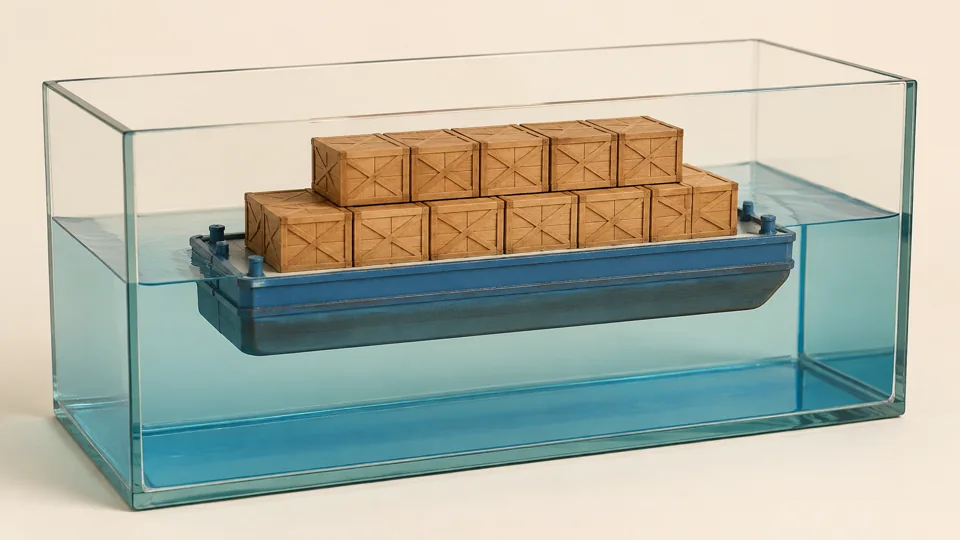 Interactive exploration
Load a tiny barge and watch its waterline rise along the hull. Then lower a block through a tank to connect water pressure with buoyancy.
 Interactive exploration
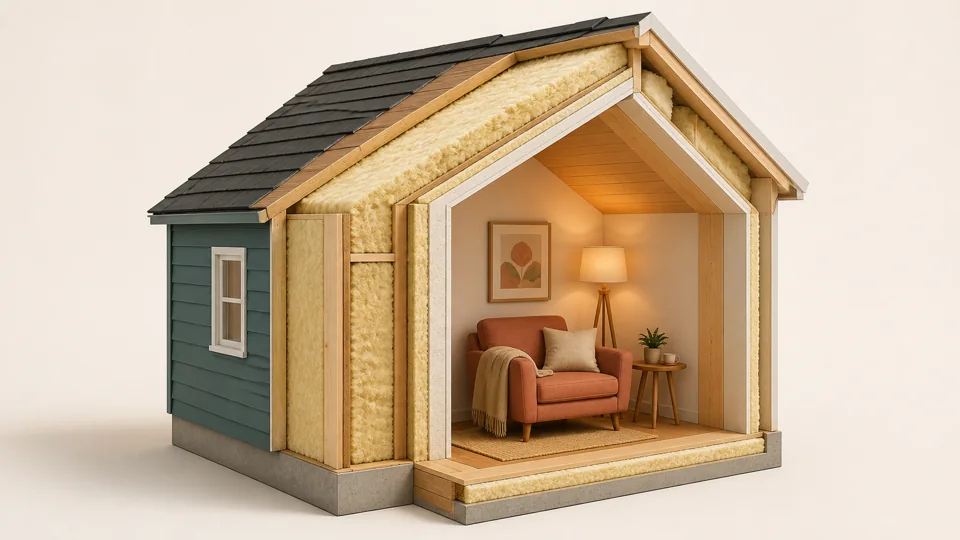
Open a house wall. Swap its added layer, make it thicker, and reverse the temperatures to see why insulation helps in winter and summer.
 Interactive exploration
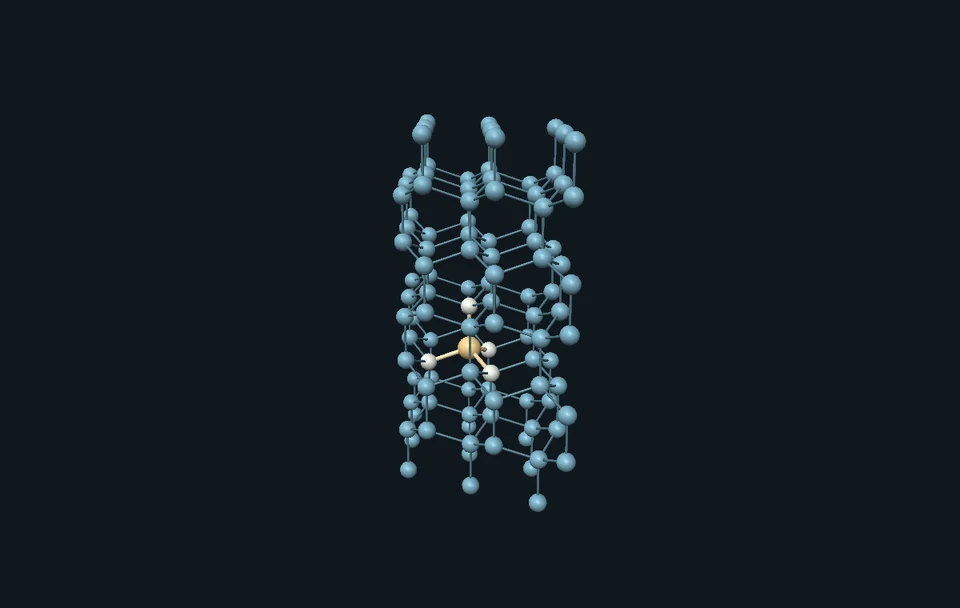
Give water an energy budget. Watch its temperature and phase masses, catch a melting plateau, compare two starting states and inspect an open ice structure.