Give heat a temperature difference
In winter, a warm inner wall face and cool outer face produce outward heat flow. In summer, a hotter outside reverses the direction. If both faces have the same temperature, the modeled net flow stops.
Open a house wall. Swap its added layer, make it thicker, and reverse the temperatures to see why insulation helps in winter and summer.
Enable JavaScript to change the conditions and run the interactive experiment.
Ordinary passive insulation resists heat transfer. It supplies no heat of its own. Heat still moves from warmer to cooler places, but a more resistant wall transfers less for the same temperature difference.
If both wall faces are 20°C, what does adding insulation do to net heat flow here?
With no temperature difference, this model has no net conduction. Passive insulation does not generate heat.
In winter, a warm inner wall face and cool outer face produce outward heat flow. In summer, a hotter outside reverses the direction. If both faces have the same temperature, the modeled net flow stops.
A material’s thermal conductivity describes how readily it conducts heat. Making a layer thicker increases its thermal resistance. The same thickness of generic insulation resists conduction more than the brick comparison here.
House walls, insulated bags and thermos flasks all limit heat transfer, but their constructions differ. A real thermos also limits radiation and convection. This wall experiment isolates conduction through flat layers.
Area-normalized resistance is R=L/k in m²·K/W. The 10 cm base brick layer and added layer are in series, so their resistances add. For the 1 m² calculation area, Q̇=A(T_inner−T_outer)/R_total.
Controls set wall-face temperatures, not indoor/outdoor air temperatures. The model omits surface convection, radiation, framing, windows and drafts. It describes a settled one-dimensional heat flow, not how quickly a room cools.
One US R unit equals 0.1761102 m²·K/W. The metric display gives RSI; imperial gives US R. The representative conductivities, 0.7 W/(m·K) for brick and 0.07 for generic insulation, are textbook examples, not product specifications.
Wrap one cup and leave the other bare. Give both the same cover and place them side by side away from sun and drafts.
Add equal amounts of cool water without ice. Measure each starting temperature promptly. Keep thermometers and lids arranged the same way.
Record both temperatures every two minutes for about 20 minutes. Compare changes from each cup’s own start. Repeat with thicker wrapping if the difference is hard to distinguish.
Will wrapping a cup slow its warming?
Cold water only; no boiling water or building-insulation fibers. Small differences, probe accuracy and room conditions can obscure the trend. Touch alone is not a reliable thermometer; this does not measure k or a whole house.
Thermal Resistance Circuits gives representative brick k=0.7 and insulation k=0.07 W/(m·K).
MIT · Thermal resistanceSteady, one-dimensional, constant-property conduction without internal generation.
MIT · Steady conductionSI Appendix B.9, thermal insulance.
NIST · Unit conversionPublished activity allows a cold-water-only investigation. The simplified adaptation below has not been trialed.
NASA/JPL · Mars ThermosIndependent subject review is pending.
Read the sources and model assumptions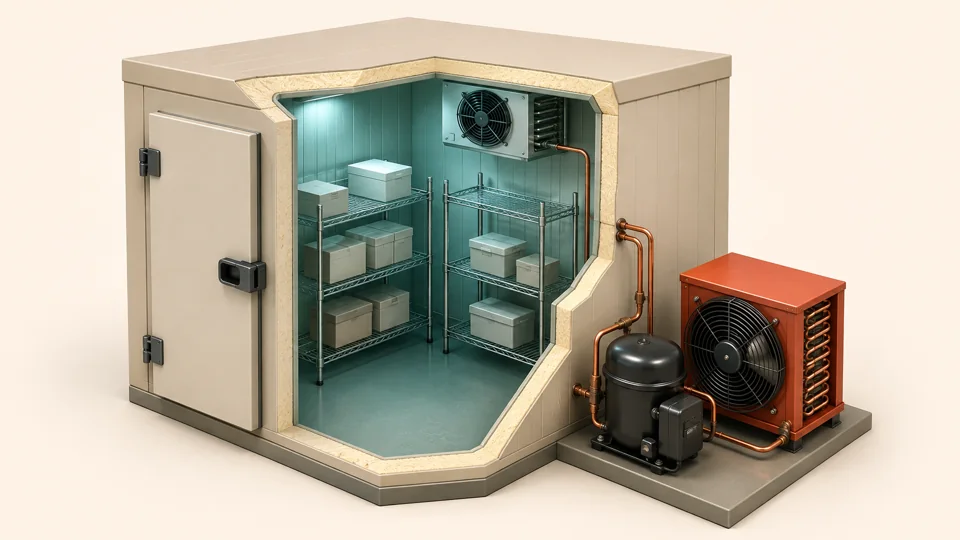 Interactive exploration
Look through a cold room and follow its refrigerant loop. Count the heat removed and the work added, then try putting both sides in the same room.
Close a switch. Follow a complete path. Give current a second route and discover what changes.
 Interactive exploration
Follow water above and below the surface. Pave part of the land, change evaporation, and watch the water budget rearrange.