Add weight and watch the hull
Cargo makes the barge settle deeper. The underwater volume grows until the displaced-water weight balances the boat and cargo weight. The surface stays level; the waterline rises along the hull.
Load a tiny barge and watch its waterline rise along the hull. Then lower a block through a tank to connect water pressure with buoyancy.
Enable JavaScript to change the conditions and run the interactive experiment.
A floating object pushes aside water whose weight equals its own. A broad, hollow hull can exclude much more water than a compact piece of the same material—but only while water stays out.
A fully submerged block is held deeper in the same water. What happens to its buoyancy?
Both face pressures rise. Their difference depends on the block height, so the net buoyant force stays ρgV.
Cargo makes the barge settle deeper. The underwater volume grows until the displaced-water weight balances the boat and cargo weight. The surface stays level; the waterline rises along the hull.
This rectangular barge has a 30×20 cm footprint and a 5 cm rim. At 3 L of displaced water, the rim reaches the surface. The model stops there because water can enter; it does not pretend a flooded open hull remains a sealed box.
Water pressure grows with depth. On a fully submerged rectangular block, the bottom gets a stronger upward push than the top gets downward. The horizontal pushes balance. Their net vertical effect is buoyancy.
Fᵦ=ρgV_submerged. For static floating balance, mg=ρgV_submerged. A 0.6 kg sealed block displaces 0.6 L in the 1000 kg/m³ water preset. Its total size still matters: it must have enough external volume available.
For a fully submerged fixed-volume block in uniform-density liquid, increasing depth raises top and bottom pressures together. Their difference—and the net buoyancy—stays the same. A virtual support holds the pressure-view block.
An object’s mass divided by its external volume helps decide whether it can float under these assumptions. Remaining upright is another problem. Hull shape, center of mass, waves and flooding matter for real stability.
Fold foil into a broad tray with upright sides. Smooth the corners, check for holes and float it in shallow water. Keep small items away from young children.
Add identical cargo pieces one at a time near the center. Look from the side at the waterline. Stop before water enters or the boat tips.
Dry and rebuild with the same foil. Compare a narrower shape while keeping cargo type the same. Record leaking or tipping as different failure modes.
How does the waterline change as you add the same kind of cargo?
No passenger or real-boat claims. Foil can leak or collapse; a crumpled foil ball may trap air and float. This adapted procedure has not yet been physically trialed.
Academic derivation, submerged fraction and floating/neutral/sinking comparisons.
OpenStax · BuoyancyHydrostatic scope uses a fixed-density teaching liquid.
OpenStax · Fluid pressureOriginal Teisha Rowland activity. The adapted activity below is not a seaworthiness test.
Science Buddies · Foil boatsIndependent subject review is pending.
Read the sources and model assumptionsSqueeze a hydraulic brake. See inside the caliper, change piston sizes, and discover how pressure becomes force.
 Interactive exploration
Follow water above and below the surface. Pave part of the land, change evaporation, and watch the water budget rearrange.
 Interactive exploration
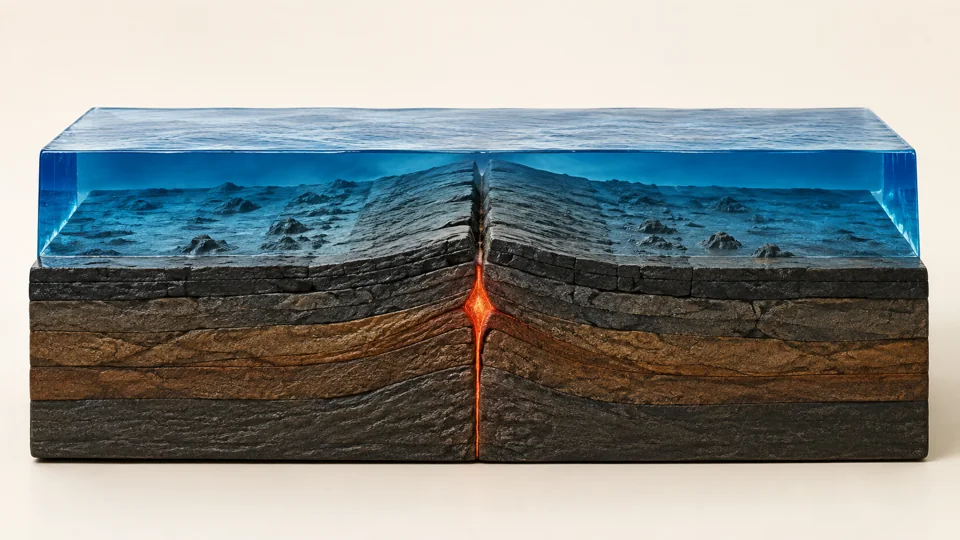
Pull a ridge apart over millions of years. Read the age and magnetic pattern left behind, then compare spreading, sliding and subduction.