One step multiplies
Put one marker at pH 3 and another at pH 5. The lower-pH sample has 100 times the hydrogen-ion activity: ten times, twice. pH is a logarithmic label, not an acid percentage or a linear amount.
Compare a hundredfold difference, transfer a tiny aliquot, turn a virtual burette and uncover why a weak acid and a strong acid reach different pH values at equivalence.
Enable JavaScript to change the conditions and run the interactive experiment.
A pH step is a multiplication in hydrogen-ion activity. To predict mixing, combine amounts first—then let all the species reach equilibrium.
A sample at pH 3 has how much greater hydrogen-ion activity than one at pH 5?
Two pH units correspond to 10² = 100. The lower pH has the greater activity.
Put one marker at pH 3 and another at pH 5. The lower-pH sample has 100 times the hydrogen-ion activity: ten times, twice. pH is a logarithmic label, not an acid percentage or a linear amount.
Water forms both hydronium and hydroxide ions. At extreme dilution, these matter. Formal HCl concentration 10⁻⁸ mol/L does not make a pH 8 base; our model gives about pH 6.978.
Adding water preserves the dissolved amount and changes concentration. A serial transfer carries only a measured fraction into a fresh vessel. The rest of the previous sample stays behind. The receiving vessel is not secretly growing millions of times larger.
Acetic acid and acetate differ by one proton and one unit of positive charge. Acetate can accept a proton from water. Diluting acetic acid can increase the fraction in acetate form even as hydronium concentration falls.
Our two virtual acids start with equal acid amounts. Each reaches stoichiometric equivalence after the same NaOH volume. Their pH values differ there because acetate is a weak base in water. An indicator endpoint and chemical equivalence are different concepts.
Two buffers begin at comparable pH values with different acid-family amounts. The same small base addition changes the smaller-inventory sample more. pH alone does not tell you how much acid or base a sample can take up.
pH = −log₁₀ a(H⁺), where a is dimensionless activity. The solver approximates this by −log₁₀([H₃O⁺]/c°), c° = 1 mol/L. Displayed results are ideal-model pH. Neither pH nor the simulator is a chemical hazard scale, and 0–14 is not a universal physical limit.
At fixed 25°C, let h=[H₃O⁺], o=[OH⁻], a=[acetate], u=[acetic acid]. Use ho=kW, ha/u=kA, a+u=CT and h+CNa=o+CCl+a. Combining these gives F(h)=h+(CNa−CCl)−kW/h−CTkA/(kA+h)=0. F is strictly increasing for h>0; logarithmic bisection finds its unique positive root.
The NIST evaluation selects pKa=4.756 at 298.15 K, zero ionic strength and a molal standard state, with nominal pressure 0.1 MPa. This ideal molar model deliberately uses kA=10⁻⁴·⁷⁵⁶ mol/L without its small molar/molal conversion or activity corrections. The concentration water product kW=10⁻¹⁴ (mol/L)² is rounded; thermodynamic constants with standard-state factors are dimensionless.
HCl adds chloride inventory; NaOH adds sodium inventory. The acid-family total counts HA and A⁻ together. Hydronium is solved after mixing; it is not a separately conserved reagent count. Adding another excess-OH value after solving would double count the base.
In this model neutrality is h=o, giving pH=7 with the rounded kW. IAPWS R11-24 Table 3 gives rounded molal pKw 13.99 at 25°C and 13.26 at 50°C, using liquid density at 0.1 MPa below 100°C. This source comparison does not turn the 25°C acetate solver into a temperature-dependent model.
25.0 mL of 0.010 M acid contains 0.250 mmol. Adding 25.0 mL of 0.010 M NaOH reaches equivalence for either selected acid. The model gives pH 7.000 for HCl and 8.228 for acetic acid. At acetic half-equivalence it gives 4.760523, close to but not exactly 4.756. Henderson–Hasselbalch is exact here only with the actual equilibrium species ratio.
The two PubChem3D conformers provide computed geometry and connectivity. They do not predict pKa, solution snapshots or proton-transfer trajectories. Acid atom 8 is the carboxyl hydrogen; the three methyl hydrogens remain in acetate. An SDF charge assignment is not an MMFF partial charge or a pharmacophore label.
Acetate’s connection table serializes one single and one double C–O bond. Its charge and bonding are delocalized over the carboxylate group. Our symmetric C–O rendering avoids implying a permanently privileged oxygen or rapid switching between separate structures.
A pH reading answers an activity question. It does not by itself reveal every dissolved species, total acid amount or whether water is suitable for a particular use.
A measured reagent amount can reveal an unknown amount. The chemistry determines the relationship between equivalence and an indicator endpoint.
Conjugate acid/base inventories can take up additions while pH changes less. Comparable initial pH values do not guarantee comparable responses.
Mark pH 2 through 8 at equal distances. Put fictional A at 3 and B at 5. Write your predicted activity ratio before revealing the powers of ten.
Write 10⁻³ beside A and 10⁻⁵ beside B. Divide the activities to find 100. Explain why subtracting the pH labels gives an exponent, not a concentration difference.
Use the HCl model cards: 10⁻³ M → pH 3.000, 10⁻⁷ M → 6.791 and 10⁻⁸ M → 6.978. Plot the positions and explain water’s contribution near neutrality.
Two fictional 25 mL samples contain 0.250 mmol and 0.00250 mmol HCl. Add the amounts, then divide by the combined 50 mL. This gives 0.00505 M; the model gives pH 2.297, not the average of 2 and 4.
Each selected acid starts with 0.250 mmol. Circle the 25.0 mL NaOH addition on both curves. Compare pH 7.000 with 8.228 and identify the acetate left in the second sample.
Predict what doubling both fictional acid amounts and volumes would do to concentration and pH. Check by division. Explain why amounts double while concentration and the ideal equilibrium pH remain unchanged.
Can a few amount cards overturn an intuitive pH prediction?
Use fictional sample cards only. No real reagents, household-product mixing or tasting. The observations are calculated examples, not measured chemical results.
100 times greater hydrogen-ion activity 10^(5−3)=100; an activity ratio is not a total-amount ratio.
No, concentration and equilibrium are different factors The selected dissociation equilibrium and the analytical concentration play different roles.
No, water equilibrium keeps this case slightly acidic The ideal solver gives pH 6.978 rather than 8.
Approximately pH 2.297 Combine amounts and volume, then calculate equilibrium.
No, the acetate-containing solution at equivalence is basic HCl gives 7.000; the acetic-acid case gives 8.228 in this model.
No, the other ions complete the charge balance h+CNa=o+CCl+a includes the negative spectator/family ions.
Yes, a larger fraction of a smaller total can still be smaller 0.010→0.001 M raises the acetate fraction about 4.10→12.40%, while h decreases.
None of those from color alone Indicator response, concentration, illumination and observation uncertainty must be considered.
IUPAC Gold Book P04524. Original explanation, linked definition; no term collection copied.
IUPAC · pHBrønsted acid B00744 and conjugate pair C01266; selected HA/A⁻ pair differs by one proton.
IUPAC · Conjugate acid–base pairB00745 includes water and acetate examples.
IUPAC · Brønsted baseAcid dissociation constant entry 15441 includes the standard-state conventions needed to distinguish concentration products from dimensionless thermodynamic constants.
IUPAC · Acid dissociation constantGoldberg, Kishore and Lennen (2002), DOI 10.1063/1.1416902, §2 and Table 7.2. pKa 4.756 at 298.15 K, zero ionic strength, molal standard state, nominal 0.1 MPa. The model neglects the small molar/molal offset.
NIST · Evaluated buffer thermodynamicsIAPWS R11-24 (2024), §3, Table 3 and footnote b. The lesson uses a rounded 25°C concentration product, not the full formulation.
IAPWS · Ionization constant of waterT06387, titration terminology. The virtual stoichiometric volume is not an observed color endpoint.
IUPAC · TitrationPubChem3D CIDs 176 and 175, retrieved 7 September 2026. Original small SDF responses retained with hashes, hydrogen counts, formal charges and conformer IDs.
PubChem3D · Computed conformer methodsCID176, C₂H₄O₂, charge 0; computed conformer 000000B000000001. Original geometry retained.
PubChem · Acetic acidCID175, C₂H₃O₂⁻, charge −1; computed conformer 000000AF00000001. M CHG restates the atom charge; it is not a second charge.
PubChem · AcetateNCBI places no restrictions on molecular-data use/distribution, while noting possible rights in submitter material. These are PubChem-generated conformer records; no blanket CC0 claim about all annotations.
NCBI · Molecular-data policyACS Lesson 6.8, steps 2, 6 and 7. Source lesson media are not copied or treated as a precise cabbage-color calibration.
ACS · pH and color changeUniversity-authored organic chemistry §2.4. No textbook artwork or wording incorporated.
OpenStax · ResonanceIndependent subject review is pending.
Read the sources and model assumptions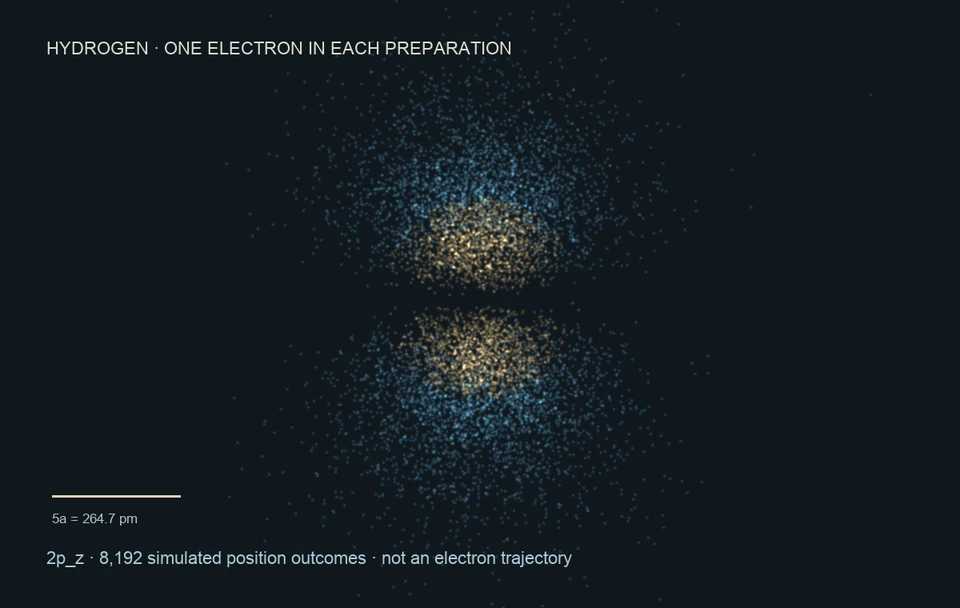 Interactive exploration
Change particle counts, pin the differences, and discover what names an element. Then prepare one-electron hydrogen states, collect possible position outcomes and match energy gaps to light.
 Interactive exploration
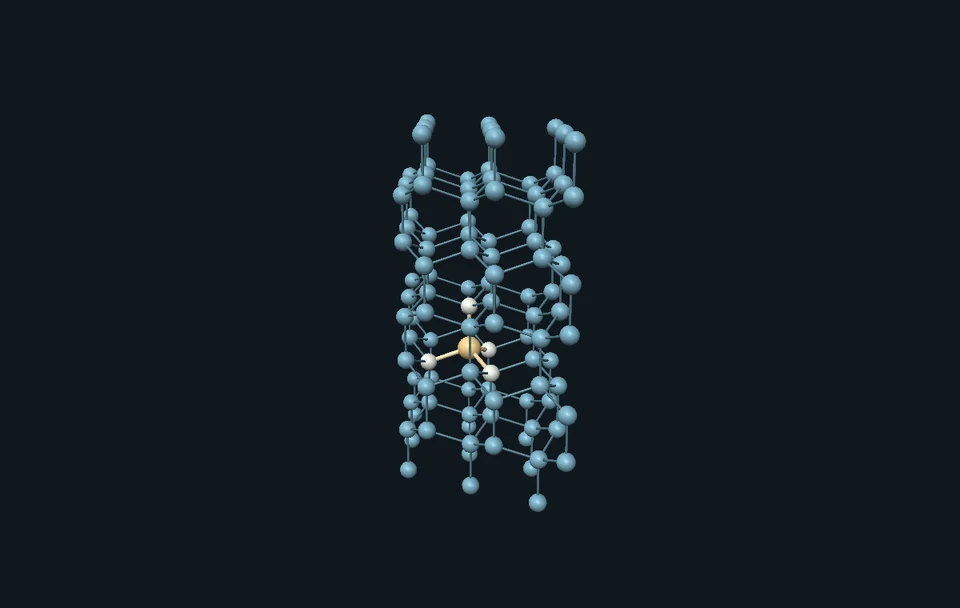
Give water an energy budget. Watch its temperature and phase masses, catch a melting plateau, compare two starting states and inspect an open ice structure.
 Interactive exploration
Follow water above and below the surface. Pave part of the land, change evaporation, and watch the water budget rearrange.