INTERACTIVE EXPLANATIONWhere can a drop of rain go next?
Follow water above and below the surface. Pave part of the land, change evaporation, and watch the water budget rearrange.
Enable JavaScript to change the conditions and run the interactive experiment.
Make a discovery
The water cycle is a network of stores and transfers, not one compulsory trip around a circle. Water can enter soil, flow over land, collect underground, return to air or remain stored. The total can stay the same while its location changes.
Make a prediction
You pave more land. Does this model create extra water?
- Yes, the river gets more water overall
- No, it sends a larger share along another path
Read the explanation
More of the same rain enters the river and less enters soil. All six stores still add to 100 units. Compare their bars, not just the river alone.
Understand it
From liquid to air and back
Evaporation transfers liquid water into vapor. Plants also release vapor through transpiration. Condensation turns vapor into droplets; precipitation can move condensed water to the surface. Visible cloud droplets are different from invisible water vapor.
Land changes the route
Impervious surfaces reduce entry into the soil and tend to increase surface runoff. The paving control changes only the split of rain into the soil and river stores. It does not model drains, local flood depths, soil saturation or a specific city.
Water can wait underground
Infiltrated water can percolate downward and recharge groundwater. Groundwater can discharge toward surface water. The underground store here is a bookkeeping compartment; real groundwater occupies pores and fractures, not usually an open underground lake.
Look closer at the science
Count the stores
Start with 100 arbitrary water units: 50 ocean, 10 vapor, 10 cloud, 15 soil, 10 groundwater, 5 river. These are teaching amounts, not global water percentages or a measured watershed.
Every transfer has two entries
Each transfer subtracts from one store and adds to another. Thus change in total storage is zero in this closed model. Rain partition is 20% + 75% × paved fraction to the river, with the rest to soil. This is an illustrative rule, not an empirical runoff coefficient.
Rates are a model choice
Fixed 0.1-unit time steps update first-order transfers. Evaporation is 0.02 × ocean × energy setting; transpiration 0.005 × soil × energy; condensation 0.08 × vapor; rain 0.12 × cloud; percolation 0.02 × soil; groundwater discharge 0.02 × groundwater; river return 0.12 × river. Time is deliberately not mapped to hours or years.
Try it yourself: Catch water that was in the air
Supplies
- 2 intact cups
- Cold water and room-temperature water
- A dry cloth and paper for notes
- Set up a comparison
Put the two cups on a water-safe surface. Fill one with cold water and the other with room-temperature water. Dry their outer surfaces carefully.
- Watch the outside
Leave both cups in the same room. Look at the outside after a few minutes. Record droplets, misting or no change. Avoid splashes so they do not confuse the observation.
- Explain the difference
If droplets appeared, connect them to water vapor cooling and condensing on the outer surface. Compare the room-temperature cup. Humidity and surface temperature affect whether you see condensation.
Will water appear outside a cold cup even when you do not spill any?
Use cups that tolerate the water temperature; no hot water or glass cutting. Water appearing outside is not leaking through the cup. This does not reproduce cloud formation or rainfall.
Sources and model limits
- Six stores with deterministic, bounded transfers. Real global water storage is distributed very differently; store sizes here are chosen for visual comparison.
- No weather forecast, precipitation triggering, soil-capacity threshold, atmospheric transport, ice/snow, water quality, withdrawals or spatial flow solver.
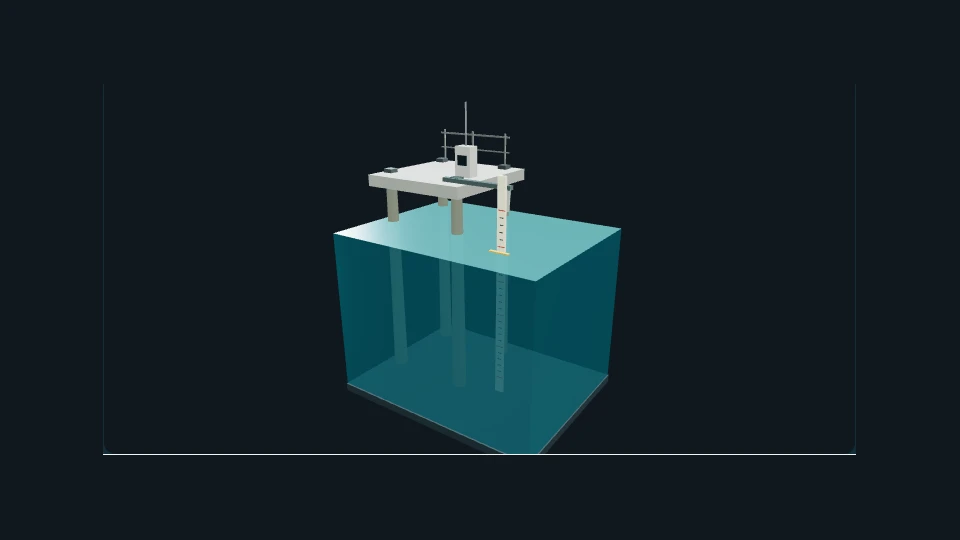
- The landscape is a projected illustration, not a map or spatial flow solver. Paving changes its appearance and the modeled rain split. Arrows and moving dots show transfer direction, not real particle routes, speeds or water amounts. Read quantities in the budget; groundwater occupies pores in the cut face. Energy affects only the two evaporation terms.
- Condensation on a cold cup depends on humidity and surface temperature. A dry result is a useful observation, not evidence that vapor is absent.
Impervious surfaces reduce infiltration and tend to increase surface runoff.
USGS Water Science School, Infiltration and the Water Cycle, land cover discussion. Supports the direction of the paving effect; the exact rain-split coefficients remain illustrative.
USGS · InfiltrationThe water cycle describes stores, transfers and human influences, rather than a single obligatory sequence.
USGS Water Science School, Water cycle, Where water is stored and How water moves sections. Supports multiple paths and human land-use framing.
USGS · Water cycleCondensation turns water vapor into liquid, including on the outside of a cold container.
USGS, Condensation and the Water Cycle. Supports the cold-cup observation and the vapor/droplet distinction.
USGS · CondensationThe USGS’s updated diagram includes human use and multiple stores and fluxes.
USGS Water Data Blog, October 13, 2022 release discussed in A New Take on the Water Cycle. Supports the decision to show a network and land-use control; no artwork is copied.
USGS · A fuller water cycleIndependent subject review is pending.
Read the sources and model assumptions