INTERACTIVE EXPLANATIONHow does a virus make copies without its own cell?
Open a real MS2 reconstruction, follow its RNA, and test what happens when a needed step is missing. Discover whose instructions, tools and materials make new particles possible.
Enable JavaScript to change the conditions and run the interactive experiment.
Make a discovery
MS2 brings RNA instructions and a protein shell. Its ordinary cycle depends on a bacterial host’s machinery and supplies. New particles are assembled; the original particle does not simply divide in two.
- Distinguish the MS2 particle from its bacterial host.
- Explain why attachment alone does not prove RNA entry.
- Separate viral instructions from the host machinery that makes proteins.
- Distinguish protein production, RNA copying and particle assembly.
- Use a parts inventory as an upper bound without calling it a particle yield.
- Interpret structural and reporter evidence without making unsupported health or timing claims.
Make a prediction
A virus particle has attached to the outside of its host. Has its RNA necessarily reached the cell interior?
- Yes: attached means inside.
- No: later entry requirements can still be missing.
- Yes: attachment proves new particles exist.
Read the explanation
Attachment is an earlier stage. The MS2 TraD comparison supports attachment-related events without detectable viral RNA entry into the cytoplasm.
Understand it
Meet a virus of bacteria
MS2 is a bacteriophage: a virus that infects certain bacteria. Its host here is a suitable E. coli cell, not a person. A protein shell, called a capsid, surrounds viral RNA. One special component, the maturation protein, helps attach the particle to the host.
Touching the outside is not getting inside
The special protein contacts the outside of a bacterial appendage called the F-pilus. But an attached particle has not necessarily delivered its RNA to the cell interior. Compare the source-linked case where attachment can occur but a later entry requirement is missing.
A message needs tools
Once positive-sense MS2 RNA reaches the bacterial cytoplasm, host translation machinery can read it to make viral proteins. The instructions are viral; the tools and molecular supplies are cellular. Reading a template does not magically turn that template into the protein.
Copying RNA is a different job
A virus-encoded replicase component works with host proteins to copy RNA. A complementary negative strand can serve as the template for new positive strands. Making a viral protein and copying the viral RNA are related but distinct capabilities.
New parts come together
New coat proteins, a maturation protein and a genome participate in assembling another particle. The source-defined mature composition contains 178 coat proteins, one maturation protein and one genome. Having enough pieces does not prove correct folding, assembly or infectivity.
Follow evidence, not just a story
A reconstruction supports an explanation of organization. An attachment image supports an observation at the cell surface. A fluorescence assay tests a molecular reaction. Put each piece of evidence beside the claim it can support; none establishes every later step by itself.
Look closer at the science
One particular virus, not a universal lifecycle
MS2 is a small positive-sense, single-stranded RNA virus of suitable bacteria. Its genome encodes coat, maturation, lysis and replicase proteins. Other viruses differ in genomes, envelopes, hosts, entry and release. MS2’s selected cycle has no required DNA intermediate or human nucleus.
Structure breaks a symmetry shortcut
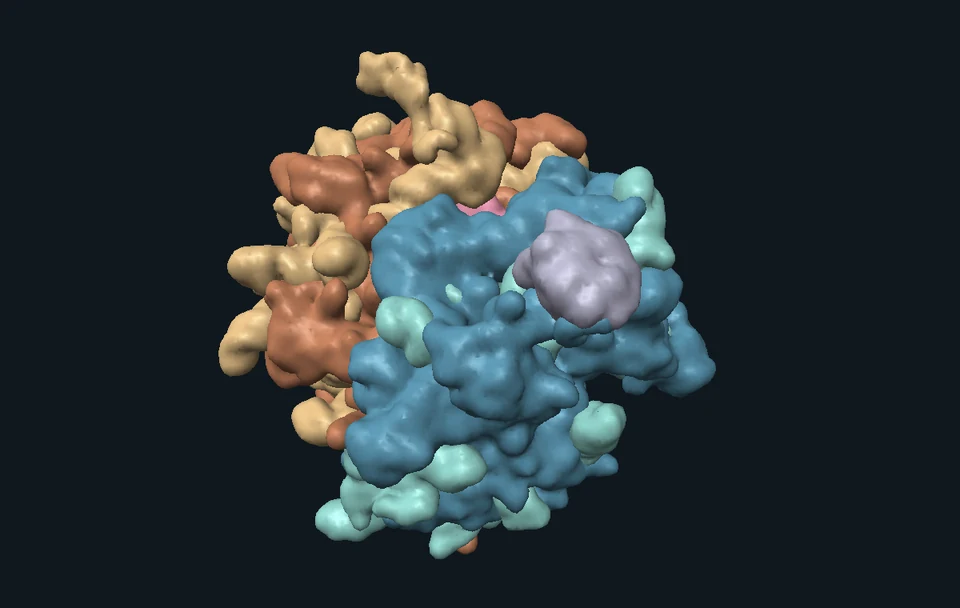
Koning et al. reconstructed an asymmetric particle containing one maturation protein in place of a coat-protein dimer. The remaining 89 dimers contain 178 coat monomers. A symmetry-averaged picture of 180 equivalent coats misses this special component. A paper grid represents this arithmetic, not actual capsid geometry.
Attachment, shell release and cytoplasmic entry
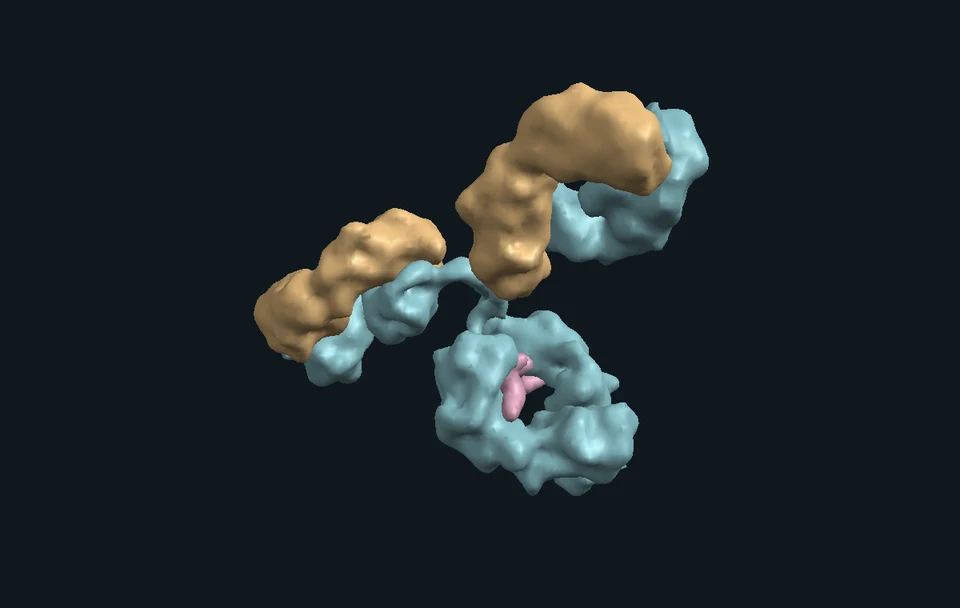
Meng et al. locate maturation-protein contacts on the pilus exterior. Harb et al. distinguish earlier binding/eclipsing events from RNA detected inside cells. In their TraD comparison, detectable cytoplasmic RNA entry was blocked while earlier events could still occur. A whole capsid travelling down the pilus lumen is not the demonstrated pathway. The detailed entry mechanism remains partly unresolved.
Source and producer are separate labels
“Virus-encoded” identifies the instructions. “Host-made” identifies the cellular translation machinery and supplies used to produce a protein. The incoming particle is not a miniature cell carrying its own independent ribosome or metabolism. Copying information does not create matter or energy.
Positive and negative do not mean electrical charge
Positive-sense RNA can serve as a translation template in this selected host context. RNA copying uses a complementary negative-strand intermediate for producing positive strands. These labels refer to sequence orientation. RNA can have different roles over time; reading a template does not inherently consume it.
A copying complex includes host proteins
Wagner, Weise and Mutschler identify EF-Tu, EF-Ts and ribosomal protein S1 in the functional MS2 replicase context. Their work also examines additional modifiers in vitro. These findings are not a dial for infection severity, and a biochemical effect does not automatically establish the same effect on infectivity.
Prepared cell-free does not mean self-sufficient
Researchers supplied components for a specific RNA reaction outside an intact cell. This is compatible with dependence on cellular machinery: the needed components were provided. The selected experiment does not recreate or measure an entire independent viral lifecycle.
Read a reporter as a reporter
In Wagner et al. Figure 2b, a synthesized RNA aptamer binds a fluorogenic ligand. Fluorescence is reported in arbitrary units. Compare complete, no-template and no-replicase conditions. The displayed baseline-relative data begin at minute 1, not an invented minute 0. Negative control differences are retained; they are not negative numbers of RNA molecules.
Replicates describe these measurements
The selected source data contain three technical replicates per condition. A mean summarizes their signals, and sample standard deviation uses n−1 in the denominator. SD is not a confidence interval. Replicates are not three people, and fluorescence is not a count of infectious particles.
Inventory accounting is a bound
For suitable counts C of coat monomers, M of maturation proteins and G of genomes, the target-set bound is min(floor(C/178), M, G). Reserving n sets leaves C−178n, M−n and G−n. This accounting does not calculate assembly kinetics, folding, actual yield or infectivity. Coat-only virus-like shells can exist without the specified mature composition.
What a reconstructed view can and cannot show
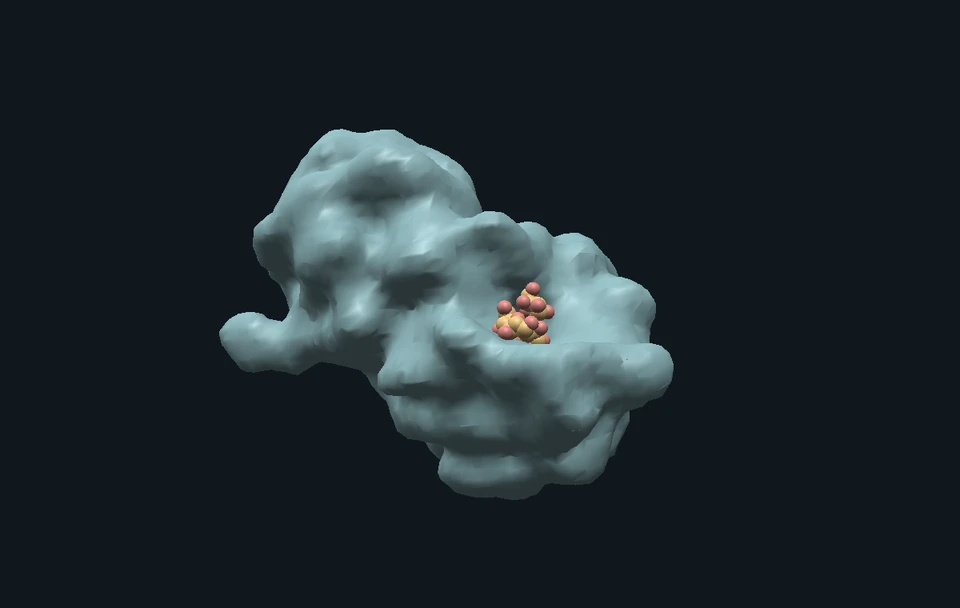
Source-derived density and fitted coordinates represent data interpreted through structural methods. Colors, clipping and exploded displays are chosen teaching operations. They are not a natural-color movie, a measured opening speed or evidence for every molecular trajectory. Structural sampling and resolution are different quantities.
Release is another distinct process
In this selected MS2 cycle, lysis protein is associated with release through host-cell lysis. The lesson does not predict when a cell lyses or how many infectious particles emerge. Other viruses can use different release routes. A successful earlier stage is not proof that the whole cycle finished.
Where this is used
Be an evidence detective
When a headline says “the virus was seen,” ask what was seen: a structural density, an attached particle, RNA inside a cell, or a functional outcome? Each observation answers a different question.
Transfer to another virus carefully
Carry the questions—what arrives, what the host supplies, what must happen next—to another sourced example. Do not carry over MS2’s exact receptor, coat count or RNA pathway without evidence.
Separate a model from a measurement
Use the parts ledger to check an explanation, then look for evidence about real assembly. A logical upper bound can rule out a proposed target-set count; it cannot prove a biological yield.
Try it yourself: Whose parts are these?
Supplies
- One sheet of paper
- A pencil
- Optional folded paper tabs
- Optional ruler for a 9 × 10 counting grid
- Whose parts are these?
Make three headings: came with MS2; host already has; newly made using viral instructions. Write cards for incoming RNA, coat shell, maturation protein, host translation tools, host copying helpers, new viral replicase, new coats and new RNA. Sort them. Explain why virus-encoded and host-made can both describe a new viral protein.
- Attached is not inside
Draw a boundary for the bacterial cell and put the incoming particle outside. Make two checkboxes: attached to the pilus; RNA detected inside. For the supplied entry-blocked comparison, check only attached. Say what separate observation would be needed to justify checking inside. Your drawing represents the source result; it is not a live experiment.
- Read instructions with host tools
Begin a fresh ordinary-route snapshot with an RNA card inside, host translation tools and cellular supplies. Add a newly made viral protein card. Now begin another fresh snapshot without translation tools. Explain why making that new protein is unsupported. Keep the snapshots separate: taking a tool away later does not erase a protein already made.
- Ask what the signal measures
On a separate page area, label a prepared assay: suitable RNA and copying components supplied. Compare its recorded fluorescence with the no-RNA and no-replicase controls in the lesson. Write “fluorescence” beside the readout and “not a virus count” below it. Explain why supplied components outside a cell do not make an isolated virus self-sufficient.
- Count a specified set of parts
Draw 90 pair-slots in a 9 × 10 grid. Each initially stands for two coat proteins. Replace one slot with a single maturation-protein card. Count 89 pairs × 2 = 178 coat proteins, then add one genome card. Label this a composition diagram. The flat grid is bookkeeping, not the shell’s shape or a folding template.
- Explain what is still unknown
Try a paper inventory of 356 coats, one maturation protein and two genomes. Reserve one target set: 178 coats, one maturation protein, one genome. The leftovers are 178, zero and one. A second complete set is not possible from these counts. Finish: “Enough parts does not prove…” Explain correct assembly, entry and infectivity as separate claims needing evidence.
Can you separate instructions, machinery, materials and evidence?
An original paper reasoning activity. Use only paper and pencil; no cultures, samples, biological materials, medicines or laboratory kits are needed. The cards model relationships and counts, not a protocol for growing, changing or testing a virus.
Check your understanding
In our MS2 example, which object is the host?
- The bacterial cell.
- The virus’s protein shell.
- A human skin cell.
- The RNA inside the virus.
Answer and explanation
The bacterial cell. Correct. Suitable E. coli bacteria are the host cells in this example. The host supplies essential cellular machinery and materials.
You see an MS2 particle attached to a pilus. What can you conclude from attachment alone?
- Its RNA has certainly entered the cell.
- It has attached, but later stages need separate evidence.
- A new generation of viruses has already assembled.
- The whole particle must travel inside the pilus tube.
Answer and explanation
It has attached, but later stages need separate evidence. Correct. An attachment image does not establish entry, RNA copying, assembly or infectivity.
A new viral coat protein is made using the MS2 RNA instructions. Which description fits?
- Host-encoded, because the host made it.
- Made by a ribosome hidden inside MS2.
- Virus-encoded and made using host translation machinery.
- Copied directly from the old coat protein without materials.
Answer and explanation
Virus-encoded and made using host translation machinery. Correct. Viral instructions specify the protein; host machinery and molecular supplies make it.
The viral replicase protein has been made. What else matters for RNA copying?
- Nothing; that protein is a self-sufficient cell.
- Only the color of the RNA drawing.
- A compulsory human nucleus and DNA stage.
- Host copying components, a suitable template and molecular supplies.
Answer and explanation
Host copying components, a suitable template and molecular supplies. Correct. The biochemical evidence identifies host factors such as EF-Tu, EF-Ts and S1; templates and substrates are also required.
What does a “negative RNA strand” mean in this MS2 explanation?
- A complementary sequence orientation.
- A molecule with negative energy.
- A bad copy that must be thrown away.
- A virus that is electrically negative rather than positive.
Answer and explanation
A complementary sequence orientation. Correct. The complementary negative strand can be a template for new positive strands. Strand sense is not electrical charge.
Why does the selected mature MS2 structure have 178 coat proteins instead of 180?
- Pausing the animation removes two proteins.
- One maturation protein occupies the place of one coat-protein pair.
- Every virus loses two proteins when it reaches a cell.
- The number counts only the proteins visible from the front.
Answer and explanation
One maturation protein occupies the place of one coat-protein pair. Correct. One special protein replaces a pair in the near-icosahedral coat arrangement: 90 pairs minus one pair gives 178 coat proteins.
You have 356 suitable coat proteins, 1 maturation protein and 2 genomes. What does the parts ledger establish?
- Exactly two infectious particles will appear.
- No coat shell of any kind could form.
- At most one complete set for the specified mature composition.
- One complete set proves successful entry into a host.
Answer and explanation
At most one complete set for the specified mature composition. Correct. One target set leaves 178 coats, no maturation protein and one genome. It is a composition upper bound, not a measured yield.
The source assay’s fluorescence rises. What has the instrument measured directly?
- The exact number of infectious MS2 particles.
- The probability that a person will become ill.
- The speed of an entire viral lifecycle inside a cell.
- Fluorescence in a prepared RNA-reporter experiment.
Answer and explanation
Fluorescence in a prepared RNA-reporter experiment. Correct. Interpreting the signal requires the specified reporter and controls. The RNA product can bind a fluorescent ligand.
A copying reaction works outside an intact cell when researchers supply the components. What follows?
- That reaction can work in a prepared cell-free system.
- An isolated MS2 particle makes all its own tools.
- All viruses can reproduce without cellular components.
- Attachment and entry are no longer different events.
Answer and explanation
That reaction can work in a prepared cell-free system. Correct. A supplied biochemical system can support a copying reaction. This does not establish an autonomous viral lifecycle.
A colored 3D reconstruction shows an RNA contact. Which claim still needs different evidence?
- The reconstruction contains an RNA-associated region.
- That exact opening motion occurred at the displayed animation speed.
- The authors used a structural method.
- The display uses chosen colors to distinguish components.
Answer and explanation
That exact opening motion occurred at the displayed animation speed. Correct. A static reconstruction does not record a timed opening sequence. Our viewing motion and cutaway are educational display operations.
Sources and model limits
- This is an authored dependency explanation of selected MS2 evidence, not a calibrated simulation of a living cell, infection probability or health outcome. Display time does not measure biological elapsed time.
- Capability comparisons are named snapshots. Changing a scenario starts a new comparison; it does not demonstrate the decay or disappearance of products already made.
- The structural parts bound assumes suitable components and omits RNA folding, co-assembly, off-pathway products and cellular context. It is not a forecast of virion yield or infectivity.
- The cell-free reporter data measure fluorescence associated with an RNA reaction. They do not count intact capsids, infectious particles, disease or clinical responses.
- Source reconstructions and pedagogical schematics remain distinct. A cutaway is a viewing operation; selected static structures do not establish a complete, timed molecular entry pathway.
The asymmetric mature MS2 reconstruction contains 178 coat proteins, one maturation protein and the RNA genome.
Koning et al., Nature Communications 7, 12524 (2016), Results and Figure 1. One maturation protein replaces a coat-protein dimer. Reconstruction and proposed assembly interpretation are not a directly filmed assembly sequence. Article media CC BY 4.0 unless separately credited.
Koning et al.: asymmetric MS2 structureMS2 maturation protein contacts the exterior of the F-pilus; reconstructed classes are not a measured time series.
Meng et al., Nature Communications 10, 3130 (2019), Figures 1–4. Figure 1a is microscopy; other panels include fitted reconstructions, a composite map and schematics. Figure 4 distinguishes a tomographic slice from mapped-back annotations. Selected figures CC BY 4.0.
Meng et al.: attachment and cell-context evidenceThe selected TraD comparison separates earlier attachment/eclipsing from detectable viral RNA entry into the cytoplasm.
Harb et al., PNAS 117 (2020), Figure 3 and Results. The proposed mechanical pathway is not a solved, timed molecular trajectory. Scientific findings are cited; no PNAS figures are reproduced here.
Harb et al.: attachment does not prove entryThe functional MS2 RNA-copying context involves viral replicase and host proteins; the chosen assay reads reporter fluorescence.
Wagner, Weise and Mutschler, Communications Biology 5 (2022), Figure 2b and Supplementary Data 2, worksheet Figure_2B+C. The source distinguishes biochemical copying from infectivity. Article and selected data CC BY 4.0; data attribution accompanies downloads.
Wagner et al.: RNA-copying components and measured controlsRecombinant coat-only particles and wild-type MS2 differ in the selected pilus-binding comparison.
Dent et al., Structure (2013), Figure 1C/D. Supports the maturation protein’s attachment role under those study conditions. Figures are not reused: the article’s CC BY-NC-ND license is unsuitable for adapted commercial assets.
Dent et al.: coat-only attachment comparisonEMD-3403 is deposited whole-particle density data; rendering choices do not make it an atomic model or live movie.
Koning et al. asymmetric reconstruction, archive EMD-3403. Preserve archive sampling, contour, source-to-render transforms and provenance. The deposited 10.5 Å resolution description differs from the paper’s 8.7 Å outside-map description; neither is independently established by our viewer.
EMDB: source density and reconstruction metadataArchive structural data have reuse terms distinct from article illustrations.
PDBe’s public data-access statement covers PDBe, EMDB and EMPIAR archive data under CC0. Source authors, record IDs and transformations remain credited. CC0 archive rights do not automatically license every publisher figure.
PDBe: archive data rightsIndependent subject review is pending.
Read the sources and model assumptions