Open a generic engine, follow what it carries and keep every bit of expelled mass in the story. Change who measures the motion, balance the thrust terms and discover what staging actually changes.
Enable JavaScript to change the conditions and run the interactive experiment.
Understand it
Carry what the engine needs
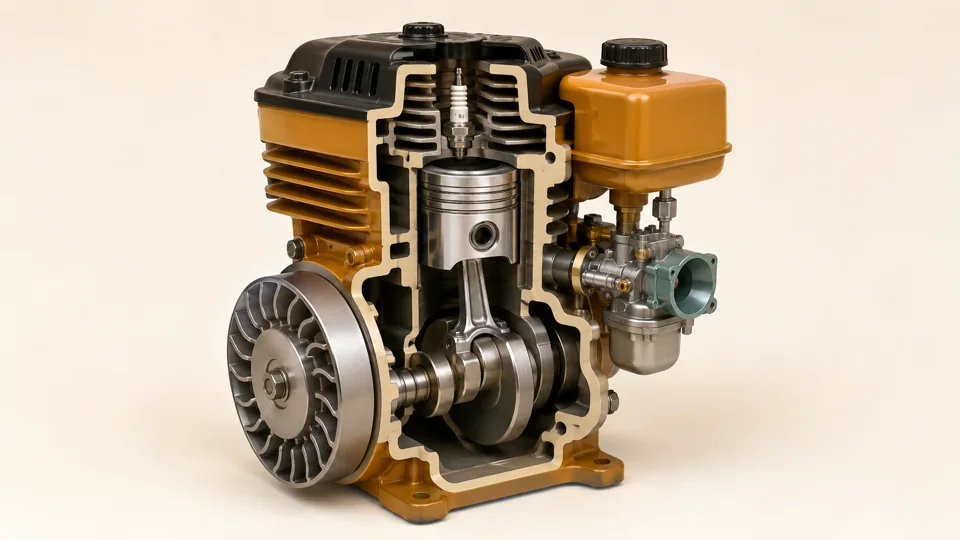
A chemical rocket carries propellant, including fuel and oxidizer, rather than depending on incoming surrounding air. Our generic pressure-fed architecture has separate gas and liquid routes. It is not a construction plan or a reconstruction of a named engine.
Trace the right route
Pressurant reaches gas spaces above the liquids. Fuel and oxidizer use separate feeds to the injector and chamber. Products leave through a throat and expanding nozzle. The inspection pointer explains connections; it is not a measured fluid transit.
Watch what leaves
The isolated one-dimensional experiment expels material backward relative to the rocket. Interactions change both parts’ momentum. Material that has left remains part of the closed account, even when it is far from the vehicle.
Keep a group’s identity
Each displayed group covers a fixed emission interval. Its marker is a mass-weighted centroid. A completed group keeps its mean inertial velocity while the rocket can continue accelerating. A group still receiving material can change its average.
Choose who measures
A forward-moving rocket can expel material that also moves forward in the initial rest frame, provided that material is slower than the rocket. “Backward” needs a reference frame. Changing the observer transforms every mass, not just the vehicle.
Separate two thrust contributions
The outgoing momentum flux supplies one thrust term. A difference between exit and ambient pressure supplies another signed term. Under fixed exit conditions, reducing ambient pressure can increase thrust; surrounding air is not what propulsion requires.
Make a fair comparison
With fixed mass endpoints and constant relative exhaust speed, changing flow rate changes thrust and burn duration but leaves ideal delta-v unchanged. Adding retained payload changes both initial and final mass and reduces the mass ratio.
Discarding is not burning
Ideal separation without impulse leaves both parts at their previous velocity. Carrying less empty hardware benefits the later burn. Keep discarded hardware and both exhaust populations in the ledger instead of making their mass disappear.
Look closer at the science
Generic architecture, distinct physical experiments
The engine geometry is an original representative pressure-fed arrangement. Tank fills encode normalized usable-propellant fractions, not equal liquid volumes or a mixture. Feed pressure, propellant formulation, ignition, construction dimensions and detailed thermal/fluid behavior are not supplied. The ideal burn, pressure comparison, vertical burn and staging inventory use separately stated assumptions.
Thrust from momentum and pressure
For steady axial flow, F=q uₑ+(pₑ−pₐ)Aₑ. q is positive expelled mass flow; uₑ is physical exit speed relative to the engine; pₑ and pₐ are absolute pressures; Aₑ is exit area. Both terms have force units. The pressure contribution can be negative while total thrust remains positive.
Effective speed and specific impulse
For q>0, effective speed is c=F/q=uₑ+(pₑ−pₐ)Aₑ/q. Specific impulse is Isp=c/g₀, with conventional g₀=9.80665 m/s². Isp has units of seconds but is not burn duration. The off-state has no operating F/q result; the display avoids division by zero. Two introductory NASA pages contain a malformed intermediate effective-speed expression; the correct formula here follows the thrust equation, dimensions and MIT derivation.
The isolated changing-mass model
This one-dimensional, nonrelativistic model prescribes constant c and q with no external force. It uses an ideal collimated exhaust whose relative speed equals c. This is a pressure-matched idealization for literal mass trajectories; the separate pressure lab’s effective c is not silently substituted for its physical exit speed. Vacuum alone does not remove gravity.
Mass endpoints and the logarithm
During a burn, m(t)=mᵢ−qt and v(t)=v₀+c ln[mᵢ/m(t)]. Ideal delta-v is c ln(mᵢ/mf). Initial and final masses are total retained vehicle masses, including structure, engine, tanks, payload and any retained pressurant. Final mass is not just empty structure if payload remains.
Position, cutoff and coast
The exact isolated position is x=x₀+v₀t+(c/q)[mᵢ−m−m ln(mᵢ/m)] during the burn. A stable small-time series avoids subtracting nearly equal numbers. At cutoff, mass and velocity are continuous, thrust becomes zero and subsequent isolated motion is x=xb+vb(t−tb). Zero flow or zero propellant has a deliberate no-burn coast state.
The default quantitative example
For 1000→ 500 kg, c=2000 m/s and q=25 kg/s, the burn lasts 20 s. Thrust while burning is 50 kN. Final speed gain is 1386.294361 m/s and position at cutoff is 12274.112778 m from a stationary origin. Isp is 203.943243 s. These are fictional inputs and calculations, not measured engine performance.
Open and closed momentum accounts
The default thrust impulse is 1,000,000 N·s, while rocket-only momentum at cutoff is 693147.180560 kg·m/s. They need not be equal because material crosses the rocket boundary. In the complete isolated system, all exhaust momentum is the opposite amount when starting at rest. The display sums actual recorded groups and reports its numerical residual.
Exact emission groups
Material emitted at time τ has inertial speed w(τ)=v(τ)−c and later position x(τ)+w(τ)(T−τ). For a fixed interval, its marker uses the mass-weighted integral of this position. Cumulative exhaust momentum EP(t)=mᵢv₀−m(t)v(t); cumulative first spatial moment EX(t)=mᵢ(x₀+v₀t)−m(t)x(t). Differences of those functions plus subsequent uniform motion give each interval’s exact momentum and centroid. Completed groups do not gain later material.
Changing inertial observers
For a constant observer velocity U, every part transforms as v′=v−U and x′=x−UT. The closed sums are Σm=mᵢ, Σmv′=mᵢ(v₀−U) and Σmx′=mᵢ[x₀+(v₀−U)T]. An automatically fitted camera is not an accelerating physical frame. The kinetic energy of a whole group is not obtained by pretending all its material shares the mean velocity.
A conditional nozzle-pressure comparison
The separate example freezes q=20 kg/s, uₑ=2000 m/s, pₑ=80 kPa and Aₑ=0.1 m². Ambient pressure 0/50/100 kPa gives momentum thrust 40 kN and pressure contributions +8/+3/−2 kN, totaling 48/43/38 kN. Effective speed is 2400/2150/1900 m/s, while prescribed physical exit speed stays 2000 m/s. Real nozzle flow, separation and changing exit conditions are not solved.
A short vertical burn with external forces
This fixed example starts at rest with 1000 kg, burns 100 kg, and uses c=2000 m/s, uniform g=9.80665 m/s², still-air density 1.2 kg/m³ and a chosen constant CdA. The equation is v′=cq/m−g−(ρCdA/2m)v|v|. The two flow choices initially exceed weight. The record stops at its own cutoff; it does not calculate an apogee, orbit or pad-contact failure.
The vertical speed budget
For q=10 kg/s and CdA=.5 m², ideal delta-v 210.721031 m/s minus gravity loss 98.0665 m/s minus drag loss 11.468978 m/s gives cutoff speed 101.185553 m/s. Height at its 10 s cutoff is 516.190975 m. The q=20 kg/s comparison cuts off after 5 s with greater speed but less height at that earlier time. Integration uses fixed 2 ms RK4 steps, with interpolation for display positions.
Why staging helps later
The fixed inventory is 600 kg first-stage propellant, 100 kg first-stage dry mass, 200 kg second-stage propellant and 100 kg final retained mass. With c=2000 m/s in both isolated burns: 1000→400 kg adds 1832.581464 m/s; 400→300 kg no-impulse separation adds zero; 300→100 kg adds 2197.224577 m/s. Total is 4029.806041 m/s. Keeping the empty stage yields 3218.875825 m/s. All discarded and expelled parts remain in the signed momentum ledger.
Finite paper packets are a different update rule
For a packet Δm with relative speed u measured against the post-ejection rocket, conservation gives vnew=v+uΔm/M, with packet velocity w=vnew−u. Five 1 kg packets from a 10 kg start with 5 kg retained and u=10 m/s give final speed 1627/252≈6.456349 m/s. Smaller packets approach the continuous 10 ln 2≈6.931472 m/s limit. Five large packets are not claimed to equal continuous flow.
Sources and model limits
- All performance parameters are fictional teaching inputs. The generic pressure-fed geometry supplies topology, not a measured engine, operating specification or construction plan.
- The ideal burn is one-dimensional, nonrelativistic and free of external forces. Its literal exhaust trajectories use a declared ideal collimated relative-speed model.
- The pressure comparison freezes its exit conditions. It does not solve nozzle flow, separation, atmospheric variation or engine transients.
- Every emission group is a mass-weighted interval. Its marker size is illustrative, and its centroid does not supply total exhaust kinetic energy or a measured molecular trajectory.
- The observer has constant velocity. Auto-fitting a camera is only a display operation, and positions/velocities are labeled in the selected frame.
- The short vertical model has uniform gravity, density and prescribed CdA. It terminates at cutoff, with no guidance, curvature, rotation, variable atmosphere, heating or apogee calculation.
- Staging positions are an event inventory, not a separation trajectory. The no-impulse event does not grant the expelled hardware an unmodeled kick.
- The source photograph is historical NASA evidence, separate from the fictional model. It does not imply NASA review, endorsement or measured performance for the lesson.
- Paper movement is bookkeeping, not physical momentum measurement. The activity is untrialed and uses no propelled object, pressurized container, propellant or launch apparatus.
Onboard reactants and the two thrust terms
NASA Glenn Rocket Engine, Exit Pressure and Thrust Equation sections. Correct steady thrust equation; no surrounding-air requirement is inferred.
NASA Glenn · Rocket thrust equationClosed-system momentum and effective exhaust speed
MIT 16.522 Lecture 2, pp. 1–4, Eqs. 1–11,14,17 and discussion below 19. This independently supports c=uₑ+(pₑ−pₐ)Aₑ/q; no lecture artwork is reproduced.
MIT · Space propulsion fundamentalsChanging-mass rocket equation
NASA final logarithmic derivation. Its current intermediate effective-speed expression is malformed; the lesson follows the correct thrust equation and MIT relation instead.
NASA Glenn · Ideal rocket equationImpulse and specific impulse definitions
NASA total-impulse and final Isp relations. Specific impulse is not burn duration. The same intermediate algebra issue is handled with the independently checked equation.
NASA Glenn · Specific impulseConventional standard gravity
D.R. Tate, NBS Technical Note 491, 1969, §6, printed pp. 4–5/PDF pp. 10–11: standard g₀=9.80665 m/s². It differs from local g and universal G.
NBS/NIST · Standard gravityDrag magnitude and reference-area choice
NASA coefficient and reference-area discussion. CdA values are prescribed teaching choices, not measured from the generic rocket shape.
NASA Glenn · Drag equationInitial vertical lift-off condition
NASA rocket lift-off discussion: thrust must exceed total weight in the selected vertical setting. The lesson’s two fixed flows satisfy that condition and do not model pad contact.
NASA Glenn · Thrust to weightHistorical pressure-fed architecture and its limitations
Gibson and Wood, NASA TN D-7375, 1973, Design Phase/Block I/Engine Assembly, printed pp. 3–6. Apollo SPS used helium pressurization, separate feeds and a nonthrottleable engine. The lesson is not an SPS reconstruction or throttle simulator.
NASA · Apollo Service Propulsion SystemActual historical photograph and identity
NASA owner page: Apollo 11 Saturn V launch, 16 July 1969, Pad 39A, credit NASA. The unchanged 720×900 owner-served image derivative is educational context, not model output.
NASA · Apollo 11 launches into historyEducational/editorial photograph reuse and attribution
NASA media guidance permits factual educational/editorial use under its conditions. Source credit retained; no logos extracted, endorsement implied or blanket CC0 license invented.
NASA · Images and media guidanceIndependent subject review is pending.