INTERACTIVE EXPLANATIONWhy does bread dough rise?
Slice into two teaching doughs, follow gas as it is made, kept or lost, and discover the microbes and chemistry behind rising bread. Inspect real microscopy and a yeast enzyme.
Enable JavaScript to change the conditions and run the interactive experiment.
Make a discovery
Yeast can turn sugars into products including carbon dioxide. Dough can keep some of that gas in pockets. Making gas and keeping gas are different jobs: two doughs can make the same amount but expand differently.
- Explain why gas production and gas retention can change independently.
- Account for the six carbon atoms in a simplified fermentation balance.
- Connect dough gas pockets to the porous structure of bread, while distinguishing a model from microscopy.
- Distinguish baker’s yeast, a sourdough community and chemical leavening.
- Design a fair comparison and explain why a larger percentage can still mean a smaller amount.
Make a prediction
Both teaching doughs make 100 mL of gas. A keeps 80%; B keeps 30%. Which expands more from the same starting volume?
- A
- B
- They must expand equally
Read the explanation
A keeps 80 mL, B keeps 30 mL. Equal gas production does not mean equal expansion if different amounts escape.
Understand it
What makes dough get bigger?
Gas pockets expand within a deformable dough. Baker’s yeast can produce carbon dioxide while using sugars. Some gas remains within the material and some escapes. A useful first question is not just “How much gas was made?” but also “How much was kept?”
What is fermentation?
In this yeast pathway, sugars are processed through several enzyme reactions. Carbon dioxide and ethanol are among the products. A later reaction regenerates NAD⁺, which lets glycolysis continue. Fermentation does not mean the yeast itself turns into a bubble.
What holds the bubbles?
Wheat dough is a changing mixture with a viscoelastic matrix, gas and liquid phases. Its gluten network contributes to its structure alongside starch and other components. Gas retention is not simply “how much gluten” or a row of isolated gluten balloons.
What happens when a pocket opens?
Gas can escape even while more gas is being produced. Open an escape route in our model and the kept amount falls while the escaped amount rises. No gas reappears when you close the cutaway; beginning a new trial explicitly resets the comparison.
Does yeast need all the oxygen to disappear first?
No. Baker’s yeast can ferment abundant glucose even when oxygen is available. This is called the Crabtree effect. “Fermentation only happens with absolutely no oxygen” would be an inaccurate rule for this organism.
Is sourdough just baker’s yeast?
A sourdough starter contains a community that can include multiple yeasts and bacteria. Its composition and behavior vary. Some bacteria also produce carbon dioxide; not every yeast–bacterium pairing has the same effect on rising.
Can something rise without yeast?
Yes. Leavening means making a dough or batter expand with gas. Chemical raising agents can generate gas through reactions without living yeast. That is different chemistry, while keeping gas in the material still matters.
Look closer at the science
An exact budget inside a small model
At a single fixed reference condition, newly produced gas P is divided into kept gas K and escaped gas E: P = K + E. With retention fraction η, initially K = ηP. A release action moves up to 20 mL from K to E. Both teaching doughs contain an authored 100 mL solid/liquid matrix and 10 mL initially trapped air. Their modeled volumes are V = 110 mL + K. Dissolution, pressure changes, matrix compression, vapor and spatial gas transport are omitted.
A percentage needs its starting amount
In Belz et al.’s published endpoint data, one condition retained 64.1% and reported 1435 mL retained, while another retained 99.4% and reported 311 mL retained. The latter kept a larger fraction of a much smaller reported total. These rounded means come from an instrumented experiment, not our teaching doughs. The paper’s methods and table disagree about duration, so we attach no baking-time axis to these endpoints.
Where do the six carbons go?
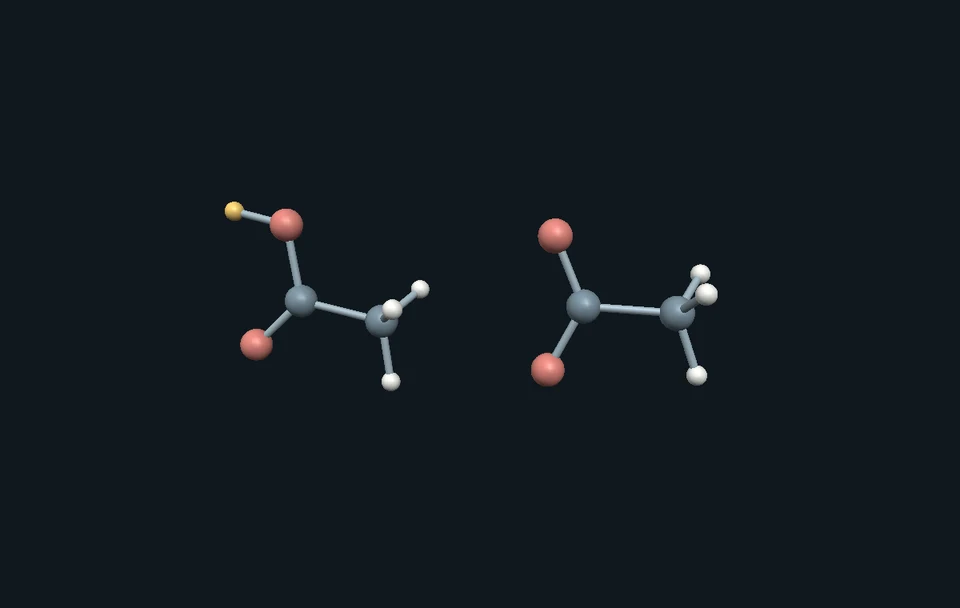
The simplified fermentation balance is one glucose to two ethanol plus two carbon dioxide molecules. Counting carbon gives 6 = 2 + 2 + 1 + 1. Our tokens omit oxygen, hydrogen, cofactors and energy bookkeeping, and their layout is not molecular geometry. The balance selects one pathway rather than every process in a growing cell.
Which step does the displayed enzyme perform?
Glycolysis produces pyruvate before this enzyme acts. Pyruvate decarboxylase, or PDC, catalyzes pyruvate plus a proton to acetaldehyde and carbon dioxide. Thiamine diphosphate and magnesium are cofactors. Alcohol dehydrogenase performs the later step that forms ethanol and regenerates NAD⁺. The PDC structure is not a complete glucose-to-ethanol machine.
Read the structural unit actually deposited
PDB 1PVD was determined by X-ray diffraction at 2.30 Å resolution. Its current deposited assembly 1 contains two protein chains, two TPP groups and two magnesium ions. The original 1996 paper describes a tetramer; we show the deposited two-chain structural unit and do not invent two extra chains. Protein envelopes and atom spheres are our representations of static deposited coordinates, not a filmed reaction.
What does real dough microscopy reveal?
Castanha and colleagues used multiphoton imaging to distinguish starch, gluten-associated signal and gas spaces in proven wheat dough. Figure 4 combines several optical channels. Its bright colors are assigned to signals; they are not the colors inside a loaf. A depth series samples different depths, not necessarily successive times during rising.
Sourdough is a variable ecosystem
Landis, Oliverio and colleagues characterized 500 starters, including 429 from the United States. Communities and measured functions varied; the study did not establish one unique local organism as the explanation for every place’s bread. Controlled experiments by Carbonetto and colleagues also showed that particular yeast–bacterial pairings do not all produce the same interactions.
Where this is used
From dough to a porous loaf
Breadmaking brings together microbial reactions, gas transport and changing material structure. Proving and baking are different stages; heating changes the system in ways our fixed-condition budget does not calculate.
Why a sourdough starter has a personality
Different organisms and conditions can produce different acids, aromas and leavening effects. A starter is a community, not a guarantee of one species, one flavor or one health benefit.
The same fraction problem appears everywhere
A high percentage of a small amount can be less than a lower percentage of a large amount. Try sorting the published gas data by percentage, then by retained milliliters. The ranking changes.
Try it yourself: Catch the gas a tiny baker makes
Supplies
- Per bottle: one packet active dry yeast; record its mass
- One US cup water (about 237 mL), checked by an adult at 105–115°F (41–46°C)
- Two tablespoons granulated sugar
- One large balloon, handled only by an adult
- A clean 0.5–1 L bottle, measuring tools, thermometer, tray and labels
- Optional matching second setup without added sugar
- Measure and label
An adult checks the water temperature and measures one US cup (about 237 mL). Label the bottle. Record the yeast packet mass. The adult gently stretches the balloon by hand; do not inflate it by mouth.
- Give yeast a mixture to work in
Stir the yeast and two tablespoons of sugar into the measured water, then transfer the mixture to the bottle. Keep the setup on a tray. This is for observation, not for drinking.
- Let an adult fit the balloon
The adult stretches the balloon opening over the bottle neck. Do not replace it with a tight cap. Keep uninflated balloons and broken pieces away from children’s mouths; discard fragments immediately.
- Record what happens
Describe the starting appearance, then look after 5, 10, 15 and 30 minutes. These are suggested observation times, not promised inflation times. A leak, balloon elasticity, initial air or temperature can affect the result.
- Change just one thing
If making a second setup, omit the added sugar while keeping other quantities and conditions matched. Record both results. Do not assume the no-added-sugar bottle must produce absolutely no gas.
- Explain and clean up
Compare your observations with your prediction. The balloon gives indirect evidence of gas collection; it does not measure pure CO₂ volume or show how gluten keeps gas in dough. An adult removes and disposes of the balloon and cleans the equipment.
Can yeast inflate a balloon, and how would you compare two conditions fairly?
Adult-led activity: an adult handles warm water and all balloons; discard broken pieces immediately because balloons can block airways. Never tightly cap the bottle, taste the mixture or inhale the gas. No flour or raw-dough play. The on-screen model and printable observation sheet are complete alternatives.
Check your understanding
A and B each generate 100 mL in our model. A keeps 80%, B 30%. Which keeps more?
- A
- B
- Equal production guarantees equal retention
Answer and explanation
A A keeps 80 mL while B keeps 30 mL. Production and retention are different quantities.
Yeast is still active, but a gas pocket opens to the outside. What can happen?
- Some gas escapes and dough volume can fall
- Every yeast cell instantly dies
- Gas turns back into flour
Answer and explanation
Some gas escapes and dough volume can fall Production and escape can happen together. In our release action, gas moves from the kept budget to the escaped budget; the total made stays unchanged.
Where do six glucose carbons go in the simplified fermentation balance?
- Two ethanol plus two CO₂ molecules
- Six CO₂ molecules and no other carbon product
- They disappear as energy
Answer and explanation
Two ethanol plus two CO₂ molecules Two two-carbon ethanols and two one-carbon CO₂ molecules retain all six carbon atoms. This is a selected pathway balance, not every process in the cell.
What does the displayed pyruvate decarboxylase directly act on?
- Whole flour grains
- Pyruvate
- Bread crust
Answer and explanation
Pyruvate Other reactions produce pyruvate first. PDC forms acetaldehyde and CO₂; a later enzyme forms ethanol.
Which published condition reported more retained gas: 99.4% of 313 mL, or 64.1% of 2241 mL?
- 99.4% of 313 mL
- 64.1% of 2241 mL
- Percentages alone decide
Answer and explanation
64.1% of 2241 mL The reported retained means were 311 mL and 1435 mL. A percentage needs a base quantity; published rounding is kept unchanged.
Is every sourdough starter the same microorganism?
- Yes, only baker’s yeast
- No; starters are variable communities
- Yes, only bacteria
Answer and explanation
No; starters are variable communities Yeasts and bacteria can occur together, and particular organisms and conditions affect the outcome. Not every pairing behaves the same.
You remove sugar but also double yeast and warm the second bottle more. Did you isolate sugar’s effect?
Answer and explanation
No Several conditions changed, so you cannot attribute the difference to sugar alone. Keep a matched comparison and record departures.
Are the blue and magenta microscopy areas the natural colors inside your loaf?
Answer and explanation
No The real microscope image uses optical channels and assigned colors to distinguish structures. Its contrast is evidence with a method, not natural-color dough photography.
Sources and model limits
- The dough, pore sections and glass vessels are authored 3D teaching geometry, not reconstructed specimens or a recipe-specific physical solver. Visible pores are enlarged sections and are not calibrated gas volumes.
- The accounting model uses a fixed matrix and initially trapped air at one reference gas condition. It omits dissolution, pressure and temperature changes, growth kinetics, matrix compression, vapor, coalescence and detailed leakage. Playback has no real proving-time scale.
- Retention is an explicitly selected fraction, not a measured flour property or gluten percentage. No temperature-to-rise, salt-to-height or sugar-to-growth prediction is claimed.
- The published salt conditions are discrete rounded endpoint data. The methods say 90 minutes and the table caption says three hours; water addition also varies. Do not interpolate them into a recipe, silently fix rounding differences or relabel dough mass percent as flour mass percent.
- The PDB viewer shows the actual deposited two-chain structural unit, not an assumed complete tetramer. Waters are omitted, TPP/Mg are retained, and protein-chain separation is only an inspection offset. Atom-sphere radii are display choices.
- Microscope images are static evidence from different preparations. Assigned optical contrast does not measure active fermentation. The home balloon measures an indirect response affected by air, elasticity, leaks and temperature; it is not a pure CO₂ volume meter.
- Independent subject review and learner trials of the finished lesson are pending. This lesson makes no individualized food, health or nutritional claim.
The yeast fermentation pathway separates glycolysis from later reactions
Source-owned Saccharomyces Genome Database pathway, including fermentation of abundant glucose despite oxygen availability. We use its pathway identities, not an old respiratory ATP estimate.
Saccharomyces Genome Database · glucose fermentationPDC releases CO₂ from pyruvate and uses TPP and magnesium
Entry 215 identifies the reaction and source structure. Magnesium contributes to cofactor anchoring. The later ethanol-producing reaction is not assigned to PDC.
EMBL-EBI M-CSA · pyruvate decarboxylaseThe displayed enzyme is an experimentally determined yeast structure
PDB 1PVD; Arjunan et al., J Mol Biol 1996, DOI 10.1006/jmbi.1996.0111. X-ray diffraction 2.30 Å. Current assembly 1 has two protein chains, unlike the tetramer described in the paper.
RCSB PDB · 1PVD and original structure paperDeposited PDB data can be reused
Archive coordinates and API data are CC0. Local meshes and source hashes are documented; unrelated site artwork is not assumed to have the same license.
RCSB PDB · usage policyReal dough contains a complex gas-cell wall structure
Castanha et al., Scientific Reports 2023, DOI 10.1038/s41598-023-39797-w. Complete Figure 4 reused under CC BY 4.0, preserving scale bars and optical-channel labels.
Castanha et al. · multiphoton dough microscopy, 2023Gas pockets and their connectivity change during proving and baking
Source-facility account of original tomography work, associated with Babin et al. DOI 10.1016/j.jcs.2005.12.002. It informs the qualitative geometry; it is not a universal growth equation.
ESRF · in-situ dough tomographyReported total gas and retention percentage can rank conditions differently
Belz et al., Foods 2017, Table 2, DOI 10.3390/foods6080066. Reported rounded endpoints kept unchanged. Duration discrepancy and varying water addition are disclosed beside the comparison.
Belz et al. · gas-production and retention endpoints, 2017Yeast and bacterial pairings have differing leavening effects
Controlled wheat-dough experiments with named strains, not a universal sourdough-community simulator.
Carbonetto et al. · sourdough interactions, 2020Sourdough starter communities and functions vary
Original study of 500 starters, with functional work on a subset. No uninspected sample-specific time course is invented in this lesson.
Landis, Oliverio et al. · eLife, 2021The yeast photograph shows real cells under DIC microscopy
Masur’s own public-domain microscopy, January 2010; file rotated by Andrew Pertsev in 2019. Synthetic complete medium and specified objective. This is not a fermentation time-lapse.
Masur · S. cerevisiae microscopyA yeast, sugar and warm-water mixture can inflate a balloon
Originating activity supplies and adult supervision. Brytalearn writes original instructions, replaces mouth inflation with manual stretching, and adds a matched-comparison worksheet.
Exploratorium · Yeast-Air Balloons activityUninflated and broken balloons require adult handling
Public safety authority warning informs the placement of adult supervision at each balloon step.
U.S. CPSC · balloons and airway safetyRaw flour can contain pathogens
The home activity uses no flour, raw dough tasting or raw-dough play. General hand and equipment cleaning remains part of the activity.
U.S. FDA · handling flour safelyAncient bread-like remains do not establish the first yeast-raised loaf
Original archaeological study of approximately 14,400-year-old remains at Shubayqa 1. Likely flatbread-like products; not 14,400 BCE or proof of leavening.
Arranz-Otaegui et al. · PNAS, 2018Independent subject review is pending.
Read the sources and model assumptions