Start with a real observation
The EHT image uses 2017 radio measurements and was released in 2019. Its orange palette displays radio brightness. It is reconstructed from observations, not visible orange light from a glowing solid surface.
Inspect the real EHT observation, then choose a direction in a calculated light map. Follow its exterior path, find its source and reveal two images of one tiny patch.
Enable JavaScript to change the conditions and run the interactive experiment.
Light from outside a black hole can reach us by curved paths. A picture, the model used to interpret it and an invented visual aid each provide a different kind of information.
A selected direction is dark in single-patch mode. What should you check before calling it captured?
A returning path may connect to an unlit part of the invented background. Ray status and illumination are separate.
The EHT image uses 2017 radio measurements and was released in 2019. Its orange palette displays radio brightness. It is reconstructed from observations, not visible orange light from a glowing solid surface.
Choose a position in the source map. The model traces the corresponding viewing direction inward from a static observer. A returning backtrace connects to a source; physical light follows that connection toward the observer in reverse.
The horizon is a causal boundary. The photon sphere is a radius of unstable circular null orbits in this geometry. Neither is the conserved impact parameter used to label an incoming ray.
A returning path reaches an outer turning point and then the invented background sphere. Its closest areal radius differs from its impact parameter. A b=6 ray turns near r=4.453, not r=6.
Some paths accumulate an extra winding. The same aligned patch can then form a broad main image and a much narrower additional feature. The source has not been duplicated.
The fine inset changes a labeled radial scale. The additional image is far below one pixel in the full impact map. A thick painted ring would hide the actual numerical scale.
With a single bright patch, many returning rays are dark because they sample an unlit direction. The capture classification remains the same when the invented source is recolored.
This spherical nonrotating vacuum model has no emitting accretion flow, spin, plasma, telescope reconstruction or physical travel time. It isolates geometry; it is not fitted to M87*.
In the classical description, the event horizon separates events that can send future-directed light signals to distant observers from those that cannot. It is not a solid surface glowing in the observed image.
The Schwarzschild exterior is nonrotating, uncharged and spherical. Set r_g=GM/c². The chosen static observer is at 50 r_g and the invented source sphere at 1000 r_g. These are authored positions, not Earth’s location relative to M87*.
A sphere of areal radius r has area 4πr². Plotting x=r cosφ and y=r sinφ gives a useful coordinate projection, but does not reproduce every proper spatial length or local angle in curved geometry.
With u=1/r and r_g=1, u″=3u²−u. The first integral is u′²+u²−2u³=1/b². The incoming derivative at the observer is determined by this relation; the code does not use a Newtonian force on a light particle.
The horizon has r=2, the unstable circular null orbit has r=3 and the critical impact parameter is b_c=3√3. For the chosen inward directions, b<b_c is captured, b>b_c returns outward, and b=b_c approaches the unstable orbit asymptotically.
The static observer measures sinψ=b√(1−2/50)/50. A local camera uses radius proportional to tanψ. An impact map instead uses radius proportional to b. Switching projection keeps the selected physical ray unchanged.
The accumulated angle can exceed 360°. First interpolate the full angle, then use its sine and cosine to find a source direction. Interpolating wrapped directions across 360° would produce a false intermediate source.
For a returning path, the outer turning radius satisfies b²=r₀³/(r₀−2), with r₀>3. It is not correct to place the turn at r=b. Finite-endpoint accumulated angle is also different from deflection defined at infinity.
The map uses 512 logarithmically spaced knots over 1.001≤b/b_c≤3.1. Independently checked midpoint angular error is below 4.781×10⁻⁶ radians. Returning mappings closer to criticality are deliberately unresolved; a colored or hatched indication is computational scope, not matter.
For the fixed aligned 2° source patch, centers occur near b=15.337679493438 and b=5.202001640146 r_g. The latter corresponds to an additional winding. Its radial width is about 0.000409681 r_g. Geometry alone does not supply observed radiometric brightness.
Under the stated background illumination, captured backward-traced directions lack a returning source connection. An unlit returning direction can also be dark. The independent status label prevents color from being mistaken for proof of capture.
The EHT combined interferometric radio measurements. Independent image reconstructions, tests with synthetic data and comparisons across observing days supported the principal structure. Reconstruction does not make the evidence an arbitrary invented drawing.
The 2019 analysis reports an emission-region diameter of 42±3 microarcseconds. Inferring mass or a horizon scale also uses distance and emission modeling. The published broad structure did not separately resolve every predicted photon subring.
A hypothetical object with the Sun’s same gravitational mass concentrated into a black hole would not automatically pull Earth out of its distant orbit. This is a same-mass thought experiment, not the Sun’s predicted future.
Ask what the instrument measured, what reconstruction was required and which colors were assigned for display. Those questions apply to radio astronomy, medical imaging and microscopy.
Connect an image direction to possible sources before interpreting multiple features as multiple objects. The same source may have several exterior light-path connections.
Compare independently formulated calculations, inspect boundary cases and state where resolution ends. Numerical agreement is evidence about an implementation, not automatic confirmation of every physical assumption.
Label one Observation, one Calculated path and one Invented source. Place the EHT caption, equation card and numbered source labels in their matching spaces.
On the coordinate page mark r=2 and r=3. On a separate impact-parameter page mark b_c=5.196. Do not use one ruler label for both quantities.
Pick one supplied b card. Match its wrapped direction to a source quadrant. Use the displayed numerical angle if you do not want to measure with a protractor.
Compare 546.764° accumulated angle with its 186.764° final direction. Remove 360° only to locate the direction; keep that complete turn in the path story.
Add b=4 as a captured backtrace with no background connection. Make a second card for a returning path whose source is unlit. Explain why their colors could match.
Choose one card and describe its source, path and observation claim. Write what is calculated, invented and left unresolved, then download your actual notes.
Can two dark-looking directions have different explanations?
A paper reading activity using supplied calculations, not a physical reproduction of gravity. No laser, falling-object or human-body experiment is needed.
Emitting matter outside the horizon Matter outside the causal boundary can emit light that reaches the telescopes. The horizon is not a glowing solid surface.
Photon-sphere r=3 r_g The photon-sphere value is a radius. b labels a ray; microarcseconds express an angle on the sky.
r≈4.453 The turning-point equation gives r≈4.453 r_g. Impact parameter and closest approach differ, and this ray remains outside the horizon.
There are different exterior connections Paths with different winding can connect the same source and observer. They need not cross the horizon.
Background mapping is unresolved The hatching reports an omitted calculation interval. It is not a newly predicted physical structure.
A reconstruction of 2017 radio observations Campaign date, publication date, wavelength and reconstruction are separate facts. The orange palette displays radio brightness.
The symmetry chosen in our model A Schwarzschild model assumes spherical symmetry. It does not measure M87*’s spin or infer it from a teaching circle.
Can also connect to an unlit source Illumination and connectivity differ. Read the independent ray classification before interpreting darkness.
Bozza 2002, sections II and III A, equations 38–50. Its length unit is 2 r_g; conversion is explicit. No figures copied.
Bozza · Gravitational lensing in the strong field limitPerlick, Tsupko and Bisnovatyi-Kogan 2015, equations 38 and 47. Only the vacuum Schwarzschild limit is implemented; plasma extensions are omitted.
Perlick et al. · Spherical shadow geometrySynge 1966, MNRAS 131, 463–466. Historical primary treatment recovered by the cited modern vacuum formula; no article figures copied.
Synge · The Escape of Photons from Gravitationally Intense StarsEHT 2019 Paper I, introduction and sections 5–7, Figure 3. The separate public JPEG has its own item provenance and CC BY 4.0 image license.
EHT Collaboration · First M87 Results IPaper VI reports the 42±3 microarcsecond emission diameter and relates image size, distance, models and inferred mass.
EHT Collaboration · First M87 Results VIJohnson et al. 2020, introduction and section 2. Do not claim every predicted subring was separately resolved in the 2019 image.
Johnson et al. · Universal interferometric signaturesNASA anatomy page explains emitting matter and lensing. The implemented horizon uses the more precise causal-boundary definition; no third-party NASA-hosted artwork is copied.
NASA · Black-hole anatomyNASA Goddard distinguishes black holes from indiscriminate suction and discusses hypothetical replacement by the same solar mass, not the Sun’s predicted fate.
NASA Goddard · Black holesESO eso1907a identifies the 2017 1.3 mm observation campaign, 10 April 2019 release and EHT Collaboration credit. Original served publication JPEG and SHA-256 are retained locally.
ESO / EHT · First Image of a Black HoleESO public image policy: CC BY 4.0 unless excepted, full visible credit and no endorsement. The item has no separate exception. This does not relicense scientific papers or code.
ESO · Image usage policyIndependent subject review is pending.
Read the sources and model assumptions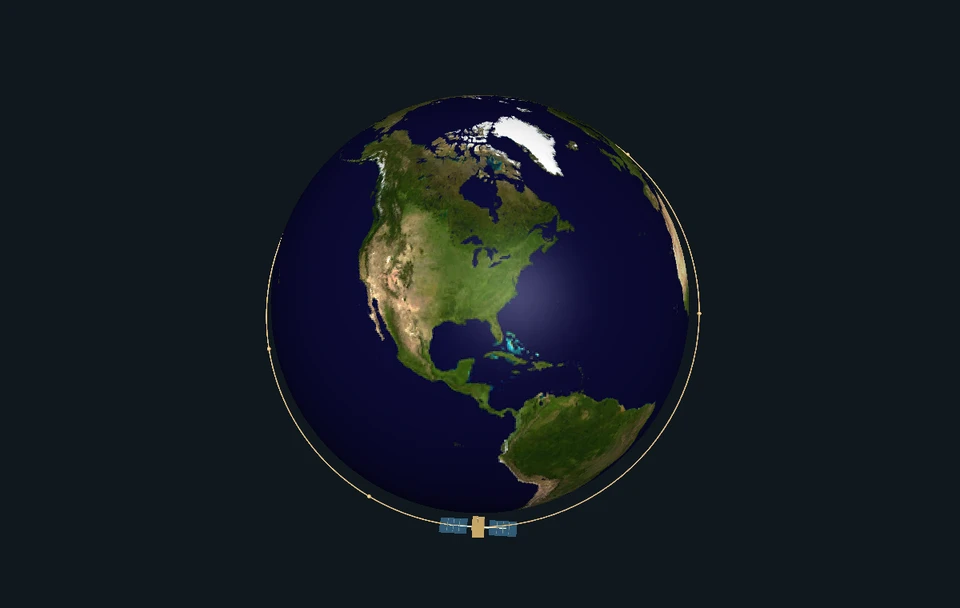 Interactive exploration
Draw a velocity arrow, predict a path and compare two spacecraft on one clock. Follow a real NASA Earth map, inspect the next moment of free fall and discover why speed alone cannot make a circle.
 Interactive exploration
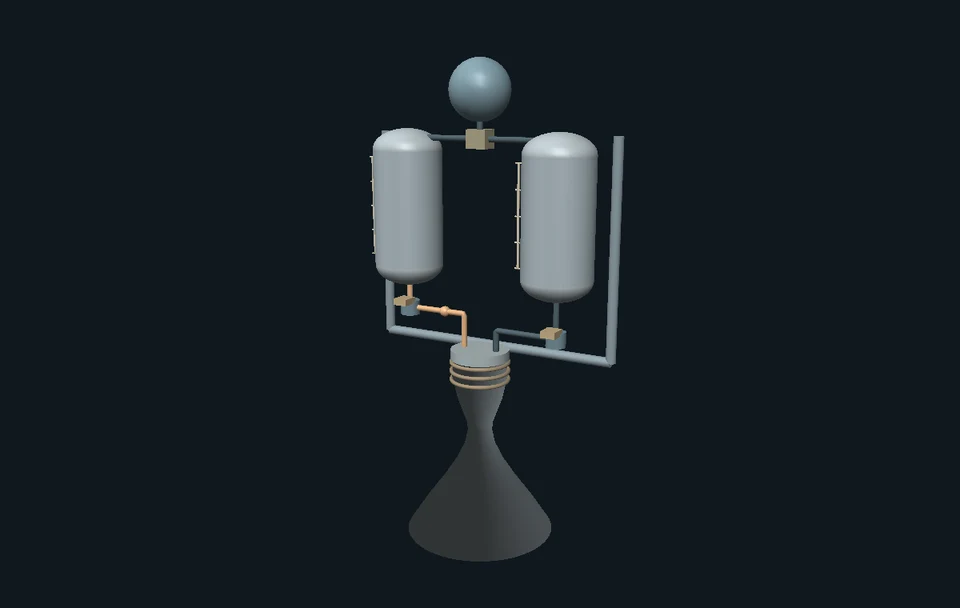
Open a generic engine, follow what it carries and keep every bit of expelled mass in the story. Change who measures the motion, balance the thrust terms and discover what staging actually changes.
Slide an object toward a lens. Follow the rays, find a sharp image, and discover the moment a camera becomes a magnifier.