INTERACTIVE EXPLANATIONWhat can a vaccine leave behind after its ingredients are gone?
Open a protein-vaccine example, build a response with traceable cell lineages, and compare later encounters. Then follow the separate route from vaccine mRNA to a protein.
Enable JavaScript to change the conditions and run the interactive experiment.
Make a discovery
A vaccine supplies a starting material. Your immune system produces the response. What can persist includes experienced cell lineages and antibody-secreting cells—not a permanent store of the original vaccine.
- Distinguish a supplied antigen from antibodies and memory cells made during a response.
- Connect native-antigen recognition, peptide presentation and helper cooperation without changing one type of object into another.
- Trace secretory and memory descendants to their parent cell lineages.
- Compare later starting conditions while retaining antigen-specific history.
- Distinguish the material supplied by a protein vaccine from the template supplied by an mRNA vaccine.
- Read a human recall study without treating an antibody measurement as a personal protection prediction.
Make a prediction
What is supplied by the protein-vaccine example?
- A noninfectious antigen protein
- Ready-made memory cells
- A live hepatitis B virus
Read the explanation
The documented example supplies an antigen. The recipient’s responding cell lineages produce antibodies and memory populations.
Understand it
Open the material, then ask what it is
Our documented protein example uses noninfectious hepatitis B surface antigen, abbreviated HBsAg. During manufacture, engineered yeast produce the protein, which is purified and formulated with an aluminum-hydroxide adjuvant. It is a selected viral component, not a live hepatitis B virus. The adjuvant helps the immune response; it is not an antibody or a memory cell.
Let the body do the recognizing
The immune system already contains different receptor lineages. A protein antigen can become available to matching B cells in its intact form. Antigen-presenting cells can process protein and display peptides with MHC II to compatible helper T cells. Tissue and draining lymph nodes connect these interactions.
Follow the family, not a magical conversion
A B cell that captures antigen can process it and present a peptide from that material. Compatible helper recognition and additional signals support the selected T-dependent response. Activated B cells divide and differentiate. Some descendants specialize in secretion; others form memory populations. The antigen itself never turns into a cell.
Separate a factory from a reserve
Plasma cells secrete antibodies. Resting memory B cells can participate in a later recall response, including generating new secretory descendants. Some plasma cells can persist and continue secretion. Turn the persistent-secretor option off: the memory record does not vanish with that display.
Compare histories at a later encounter
Choose a matching A encounter, no new encounter, or deliberately unrelated B. With earlier A memory, a matched recall route is available for A. B instead recruits another lineage in this model while the A memory remains. Both histories include ordinary innate defenses and a receptor repertoire. The unprimed comparison is not an empty immune system.
Instructions take a different starting route
The separate mRNA view represents the platform used in mRNA COVID-19 vaccines. A delivery system helps some mRNA reach the cytoplasm, where ribosomes read it to make an antigen protein. The template and the product remain different molecules. The mRNA is later broken down; it is not inserted into nuclear DNA. This branch is not the HBsAg protein formulation.
Look closer at the science
One clearly identified protein example
The ENGERIX-B prescribing information, revised May 2026, documents the formulation used to ground the material explanation. Its name identifies evidence, not a recommendation or endorsement. The lesson does not model dose, administration, schedules, eligibility or individual response.
Native recognition and linked presentation
The B receptor binds intact antigen. The CD4-helper receptor recognizes an appropriate peptide–MHC II complex. The B cell can present a peptide from what it captured, linking its antigen selection with compatible help. The grouped signals control represents several prerequisites; a successful click is not a sufficient-condition prediction for a living immune system.
Cell identities have a history
The model records each descendant’s parent and role. Expansion is biological cell division and differentiation, represented by a few layout icons. These counts are neither concentrations nor fixed daughter-cell yields. Resting memory cells do not emit the secretion arrows; plasma-cell descendants do.
Germinal centers add more than a simple branch
Real B-cell responses can include germinal-center selection and maturation involving specialized helper and stromal-cell interactions. Conventional dendritic cells and follicular dendritic cells have different roles. The executable comparison omits receptor mutation, affinity selection and this detailed anatomy, rather than claiming every first antibody is a perfect fit.
Recall is not an efficacy meter
The comparison records available components and necessary processes. It has no disease-outcome probability. Existing antibody can bind a matching antigen while memory reactivation and production of additional secretory descendants take separate steps. Protection depends on the vaccine, pathogen, person and measured outcome.
A platform explanation has boundaries
The mRNA delivery sequence abbreviates uptake, endosomal escape and cytoplasmic translation. Not all delivered RNA necessarily escapes or is translated. Its material is not conserved as one icon changing into a protein: cellular amino acids supply the separate product. No universal copy number, escape efficiency or half-life is assigned.
What the human study actually tested
Van Damme and colleagues studied adults vaccinated against hepatitis B roughly two to three decades earlier. After a further HBsAg vaccine dose, they assessed antibody and antigen-specific cellular responses, including visits seven and thirty days later. This single-group study supports recall in its participants; it did not deliberately infect them or provide a randomized naive comparison. Its measurements do not set the animation’s timing.
Where this is used
Read an ingredient claim carefully
Ask whether a product supplies an antigen, genetic instructions or ready-made antibodies. Those starting materials are different even when all are discussed in the language of immune protection.
Separate a mechanism from a study result
A mechanism explains plausible interactions. A human study measures specified outcomes in specified participants. A rise in antibody after a vaccine challenge is not itself a direct measurement of infection prevention in everyone.
Link manufacturing and biology without confusing them
Engineered yeast can be used to manufacture purified protein outside the recipient. Cytoplasmic ribosomes can make antigen after mRNA delivery in a different platform. Keeping place, material and machinery distinct makes both routes easier to understand.
Try it yourself: Make a record that survives the first encounter
Supplies
- Paper or index cards and a pencil
- Two folded paper pockets
- A large sheet for tissue, node and circulation labels
- Optional colored pencils
- Label the supplied material
Make a pocket marked supplied antigen and put an A-protein card inside. Put separate A- and B-receptor cards in the node before opening the pocket. Antibodies and immune cells are not in the supplied-material pocket.
- Keep two representations separate
Use one representative intact-A card for B recognition. Use a small pA slip in an MHC II frame on a dendritic-cell card for helper recognition. A duplicate card represents another antigen copy; it does not mean a virus is replicating.
- Record linked cooperation
After B-A captures A, put another pA–MHC II badge on that B-cell card. Bring a compatible activated helper and the additional-signals card. Write each completed prerequisite rather than awarding points for a collision.
- Draw parent links
Branch the activated B-A lineage into plasma and memory-B descendants. Put a memory-helper badge on the T lineage. Draw antibody cards only at the plasma cell’s secretion arrow. Do not relabel the antigen as a cell.
- Fold away the transient chapter
Put away the supplied-antigen display and fold the large early-response card. Retain memory in a labeled history pocket. An optional persistent plasma-cell card can keep a separate antibody-supply arrow.
- Compare the next encounter
Reveal A and inspect the earlier history before building the recall route. On a parallel sheet without A history, build a naive matching response. Compare available components and required actions—not the speed of moving your hands.
- Change the target, preserve the past
Now reveal unrelated B. Keep A memory in its pocket. Use the separate B-specific repertoire for a new response. The two-shape rule omits real cross-recognition.
- Try the separate instruction route
On another sheet, label an instruction strip mRNA and move it to a cytoplasmic ribosome outside the nucleus. Assemble a separate protein card from amino-acid marks while the template remains. Later put the instruction in a degraded pocket. Do not move it into DNA.
What stays in your history pocket when the supplied antigen card is put away?
A paper history model. No medicines, needles, biological materials, cultures or deliberate exposure. Hand-movement speed is not a measurement of immunity.
Check your understanding
What target ingredient is supplied in our documented HBsAg protein example?
- Noninfectious antigen protein
- Ready-made memory B cells
- Live hepatitis B virus
Answer and explanation
Noninfectious antigen protein The body responds to the supplied protein and generates its own adaptive response.
Why follow information to a draining lymph node?
- It stores all the body’s DNA
- It provides a place for antigen-bearing cells and matching lymphocytes to interact
- It manufactures vaccine yeast
Answer and explanation
It provides a place for antigen-bearing cells and matching lymphocytes to interact The node connects antigen access with organized cell interactions.
Which target belongs at the helper-T receptor in this protein pathway?
- A free antibody
- Free intact protein alone
- Antigen-derived peptide displayed with compatible MHC II
Answer and explanation
Antigen-derived peptide displayed with compatible MHC II The displaying cell and peptide–MHC context matter.
Which cell should have the continuing antibody-secretion arrow?
- A resting memory B cell
- A plasma-cell descendant
- A dendritic cell
Answer and explanation
A plasma-cell descendant Plasma cells specialize in secretion; memory cells participate in recall.
When the large early response subsides, must memory disappear?
- Yes, it is the same quantity as the antibody display
- No, persistent cells and antibody supply are distinct components
- The antigen must become genomic DNA
Answer and explanation
No, persistent cells and antibody supply are distinct components Persistent cell compartments are not computed from the number of antibody icons.
A memory is present. Stipulated unrelated B appears. What happens to the selected A-memory lineage?
- It automatically becomes B-specific
- It is erased
- It stays, but does not execute A recall for B
Answer and explanation
It stays, but does not execute A recall for B B can recruit another response while the A history remains.
Where are the delivered instructions read in the separate mRNA example?
- At a ribosome in the cytoplasm
- By inserting them into nuclear DNA
- Inside a secreted antibody
Answer and explanation
At a ribosome in the cytoplasm Translation makes a separate protein; the instruction is later broken down.
What does the matching-memory comparison establish?
- The viewer can never be infected
- Recorded antigen history changes the response processes available in this model
- Every vaccine lasts the same number of years
Answer and explanation
Recorded antigen history changes the response processes available in this model This is a mechanism comparison without personal or efficacy predictions.
Sources and model limits
- Qualitative causal sequences and stipulated non-cross-reacting A/B targets. Real antigens have many epitopes, and cross-recognition is more complex.
- The primary-response chapter can stand for processes across an appropriate primary course. One playback is not one dose, a schedule or a completed vaccination status.
- Existing memory in the comparison is an explicit initial condition with a recorded earlier-response history. It is not a guaranteed result for every vaccination.
- Later removes selected transient material while keeping selected persistent compartments. It is not an antibody-decay equation or a protection-duration prediction.
- The protein and mRNA examples are different platforms. The mRNA branch must not be read as an approved mRNA hepatitis B product or as instructions for making or administering a vaccine.
- No health score, personal inputs, infection challenge, laboratory interpretation or treatment recommendation is included. The at-home activity uses only paper and writing tools.
- Professional cell pictures are credited medical illustrations; the original material and transport diagrams are enlarged teaching models. They are not microscopy or measured molecular trajectories.
Specified recombinant HBsAg formulation and manufacturing origin
Section 11, Description. Noninfectious purified surface antigen produced in engineered yeast and adsorbed on aluminum hydroxide. Revised May 2026; no clinical dosing content is imported into the model.
FDA · ENGERIX-B prescribing informationActive/passive immunity, antigen specificity and memory
Institutional immunization education. The lesson selects a protein-dependent pathway and does not generalize schedules across vaccines.
CDC Pink Book · Principles of VaccinationAntigen, adjuvant and nucleic-acid delivery are different concepts
Use the separately identified antigen, subunit and adjuvant sections; no mismatched whole-microbe wording is copied.
WHO · What’s in a vaccine?The separate mRNA platform uses cellular protein-making machinery
Institutional mRNA COVID-19 mechanism explanation. No genome-insertion step, fixed molecule lifespan or current recommendation is inferred.
CDC · COVID-19 vaccine mechanismsDendritic cells and CD4 cells interact in lymph nodes
Original mouse imaging study, not a human HBsAg-vaccine timing parameter.
Miller et al. · lymph-node imagingB-cell capture supports processing and presentation to a compatible helper
Original human B/T-clone experiments preserve the distinct recognition targets.
Lanzavecchia · Nature, 1985Matched B/T encounters occur in organized node regions
Original mouse imaging, antigen-engaged B-cell relocation and cognate contacts. No source migration speed is assigned to this lesson.
Okada et al. · PLOS Biology, 2005Human recall after earlier recombinant HBsAg vaccination
Adults in a phase IV single-group vaccine-challenge study; antibody and cellular responses, not deliberate infection or a randomized naive comparison. DOI 10.1111/jvh.13125.
Van Damme et al. · Journal of Viral Hepatitis, 2019Long-lived plasma-cell secretion is distinct from resting memory B cells
Original rhesus-macaque study after memory-B-cell depletion. Species and experimental context are retained.
Hammarlund et al. · Nature Communications, 2017Human B-cell lineages can be traced through different compartments after mRNA vaccination
Original BNT162b2 study of germinal-center maturation, memory and plasma compartments. Its observations do not become a universal vaccine trajectory.
Kim et al. · Nature, 2022Vaccines support protection without an absolute guarantee for every person
Institutional qualitative mechanism explanation; no illustrated duration is adopted as a model constant.
WHO Europe · How vaccines workDeposited full HBsAg research particle
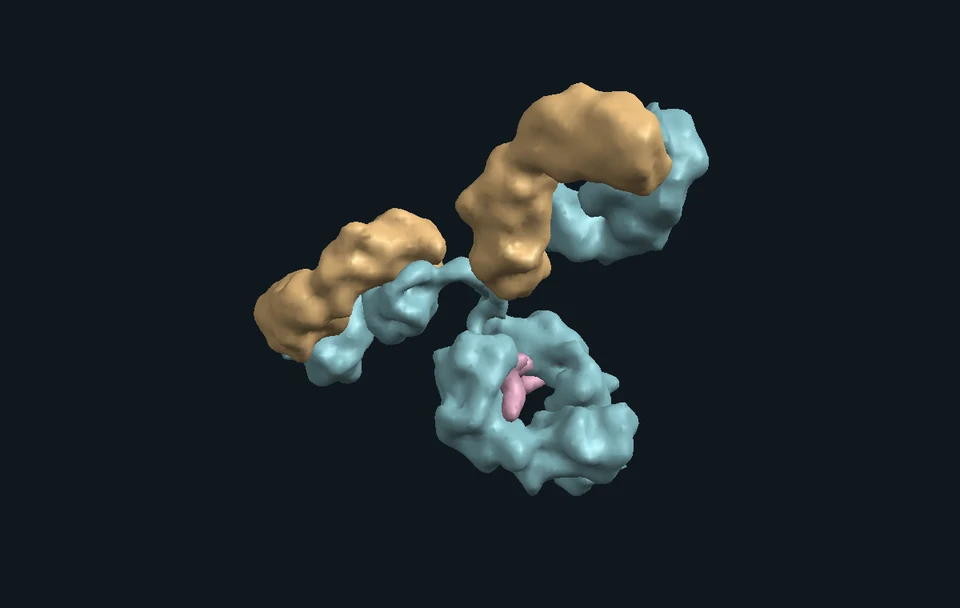
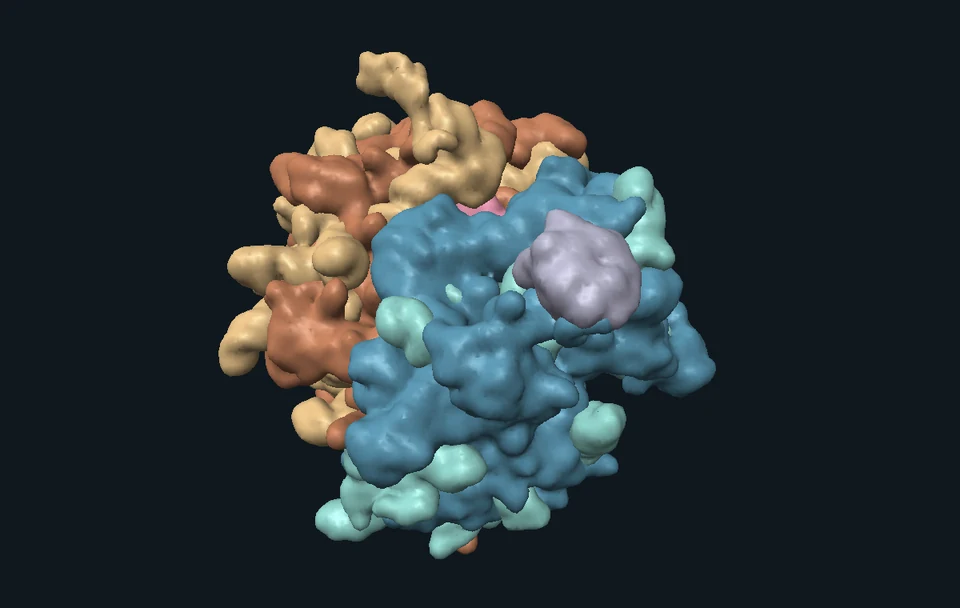
PDB 8YMJ, assembly 1: 80 protein chains already present, reported 6.6 Å reconstruction. Wang et al., Science 2024, DOI 10.1126/science.adp1453. Recombinant HEK293F research expression, distinct from the documented formulation.
RCSB PDB · 8YMJLocalized HBsAg dimer detail
PDB 8YMK, assembly 1: two S-HBsAg chains, reported 3.7 Å localized reconstruction. A dimer is not the complete particle.
RCSB PDB · 8YMKDeposited protein coordinate data reuse
PDB data CC0. Local manifests retain hashes, chain identity, common coordinate transforms and mesh processing.
wwPDB · usage policyProfessional cell references
Ryan Kissinger / NIAID Visual & Medical Arts, NIH BioArt Source. Individual image entries and public-domain provenance are linked beside the model.
NIH BioArt Source · B-cell illustrationIndependent subject review is pending.
Read the sources and model assumptions