INTERACTIVE EXPLANATIONHow do touchscreens detect your fingers?
Open a phone into its sensing layers. Move virtual touches, decode changed readings, solve a two-finger mystery and discover why different screens respond to different objects.
Enable JavaScript to change the conditions and run the interactive experiment.
Make a discovery
A screen does not know what touched it. A sensing system makes measurements, and software uses those clues to estimate positions.
- Separate protective glass, sensing electrodes, display pixels and position-estimation software.
- Explain a capacitive touch as a change in electrical coupling, without claiming a universal signal sign.
- Calculate a baseline-relative change and a weighted center from a small group of readings.
- Prove that two different arrangements can share row and column totals, then recover the missing pairing information.
- Explain why thresholding can reject interference and also discard useful signal.
- Compare capacitive and conventional four-wire resistive sensing, with device-dependent glove and pen support.
Make a prediction
P and Q give the same row totals and column totals. What could distinguish them?
- A more colorful display.
- A measurement at a crossing where they differ.
- Repeating the identical totals.
Read the explanation
The missing information is the row/column pairing. A suitable crossing measurement adds it.
Understand it
Start with the familiar thing.
Move the white contact on the virtual phone. The card follows an estimated position. Add the gold contact, then separate them to resize the card. Each change travels through our measurement and decoding steps before it reaches the app.
The glass is a cover.
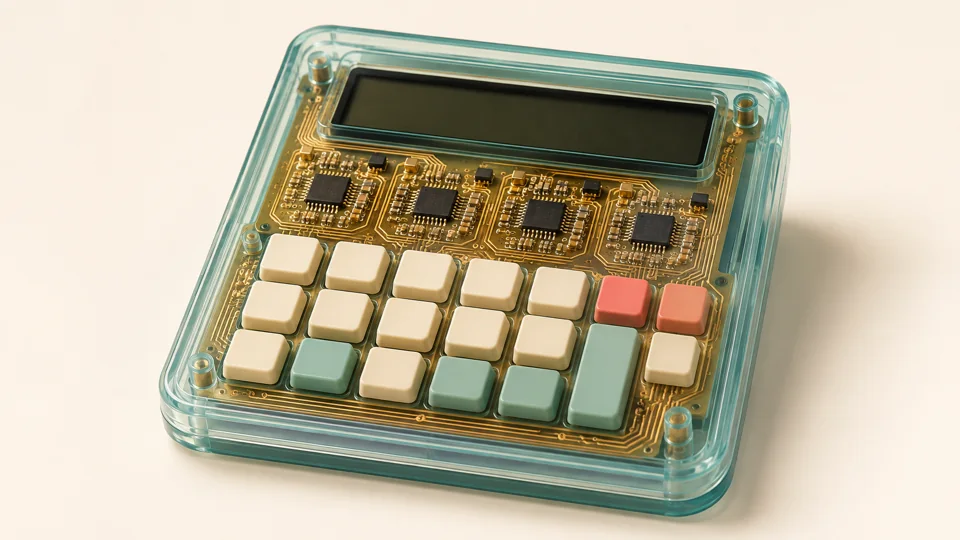
Open the stack. The cover protects the layers below. Transparent conductors can form a sensing grid. The display makes pictures. A controller processes the sensing response. Real devices may combine these layers differently; the exploded phone is an original teaching arrangement.
A change becomes a clue.
Nearby conductors can couple electrically even when insulation keeps them from touching. This is capacitance. A finger changes the electrical arrangement around a sensor. Mutual sensing drives an electrode and measures a coupled response at another. Several competing effects determine the result; touch does not always make every capacitance or register value decrease.
Compare with before.
A reading is useful in context. Our selected channel starts at 617 counts and changes to 587. The difference is 30. A larger untouched number elsewhere need not indicate a touch. The example’s sign and counts are explicitly chosen; they are not a scan of your own screen.
Find a group, then its center.
Our decoder retains readings above a threshold, joins directly neighboring cells and computes a weighted center. It receives only the matrix, not the known input positions. A detected region can combine nearby contacts or arise from interference. Software must decide whether the information is sufficient for the requested gesture.
Keep the missing information.
Two arrangements can have the same separate row and column totals. Those totals say which rows and columns were involved but lose their pairing. A carefully chosen crossing measurement can distinguish the candidates. This is an example of row–column ambiguity, one mechanism behind ghost pairings.
Look closer at the science
A deliberately inspectable sensing rule
The 12 × 9 teaching matrix uses a compact bilinear footprint: each contact contributes A × max(0, 1 − |c − x|) × max(0, 1 − |r − y|). We sum contributions, round half-up once, then add the optional 10-count interference at row 0, column 0. A is 80 or 16 authored units. This is a spatial teaching kernel, not a Maxwell solver or measured finger response.
Coordinates and register arithmetic
Input positions use integer hundredths of an electrode interval. The two axes need not have the same physical pitch; no millimeter calibration is supplied. Baseline = 600 + 3r + 2c. Current = baseline − change. All prescribed settings fit within a 0–1023 teaching register. They are synthetic counts, not picofarads, pressure, temperature or skin sensitivity.
An estimator can be precise and wrong
Retained nodes have positive change at least as large as the threshold. Four-neighbor connected components define groups. A center is Σ(c × change)/Σ(change), with the analogous row expression. Displaying more decimal places does not increase measurement accuracy. Quantization, thresholding and merged groups can shift the estimate.
Work through the trade-off
At (4.25, 3.50), the strong example yields 30, 10, 30 and 10 counts. Threshold 8 keeps all four, giving mass 80 and the original center. Threshold 12 keeps the two 30-count readings, giving mass 60 and x = 4.00. The same threshold change rejects a 10-count interference reading. Rejecting unwanted signal can also remove useful information.
Why more pixels cannot rescue a missing measurement
Our P and Q arrangements have exactly equal row totals and equal column totals. Any rule using only those totals receives identical input for both. A higher-resolution display cannot recover information that was discarded. At row 2, column 2, P yields 30 and Q yields zero in our separate crossing matrix, so this additional measurement resolves the candidates.
A distinct voltage-divider mechanism
For ideal uniform four-wire resistive sheets with one isolated pressed contact, a 3 V drive produces a measured fraction of that voltage. One third across gives 1 V; halfway down gives 1.5 V when the axes are measured in turn. We calculate these voltages without choosing an ADC rounding convention or converting the illustrated bend into force.
The real pipeline has more stages
WireTouch’s published figures show hardware, electrical waveforms, processed sensor imagery and tracked regions. Its signal frequency, displayed image rate and interpolated picture dimensions describe different things. Our small-grid decoder is independently authored, not a port of that system’s firmware or a claim to reproduce its performance.
Where this is used
Phone and tablet gestures
An app can move or resize an object using position estimates. This lesson pauses the chosen gesture when it does not have exactly the required number of separate regions, preserving the last valid position instead of selecting a convenient answer.
Gloves, pens and public screens
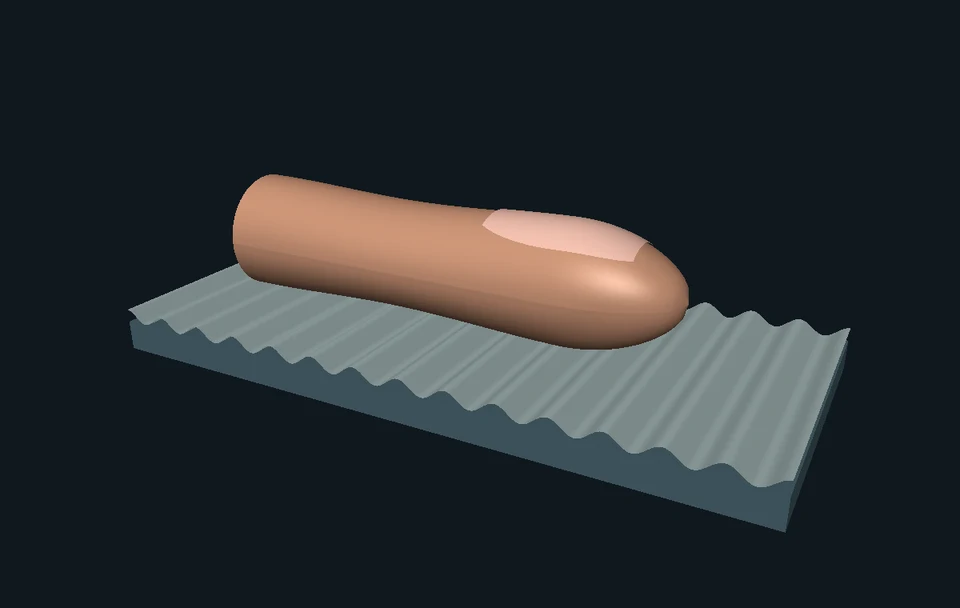
A glove changes the electrical arrangement, while a pen may use passive coupling or a supported dedicated sensing technology. Thickness, fit and controller design matter. Conventional resistive screens use pressed sheet contact instead, so the same object can work differently across devices.
A control room before the smartphone
CERN documents a capacitive touchscreen proposal in 1972, control-room use in 1976 and later work toward a more flexible X–Y arrangement. This is one source-owned history of touch interaction, not a claim to the sole invention of all touchscreens.
Try it yourself: The two-marker mystery
Supplies
- One sheet of paper
- Pencil
- Two small paper markers, or drawn circles
- Make the grid
Draw four rows and four columns. Label them 1–4. This is a paper information experiment; no electronics are required.
- Save only totals
Place markers at (row 1, column 1) and (row 4, column 4). Write how many markers each row and each column contains.
- Swap the pairing
Move them to (row 1, column 4) and (row 4, column 1). Check every total. Explain why both arrangements fit the same saved record.
- Choose a question
Ask whether (row 1, column 1) contains a marker. Compare that question with asking about (row 2, column 2). Which distinguishes these candidates?
- Keep the crossings
Record all sixteen crossing values. Circle the values that change between the candidates. Explain what the totals discarded.
Why does one well-chosen crossing measurement tell you more than making the same totals more detailed?
Markers count objects; they do not reproduce capacitance or actual touch hardware. Use paper only. The activity needs no disassembly, powered equipment or liquids.
Check your understanding
What is the protective glass doing in our opened phone?
- Recognizing fingerprints by itself.
- Covering sensing and display parts below.
- Growing a physical switch for each app button.
Answer and explanation
Covering sensing and display parts below. The stack separates protection, sensing, display and processing.
A channel was 617 and is now 587 counts. What change does our model use?
- 30 counts.
- 617 counts.
- 1,204 counts.
Answer and explanation
30 counts. Our defined convention is untouched minus current.
Raising the threshold removes useful edge readings. What can happen?
- The estimated center can shift.
- The real input must move.
- The sensor becomes perfectly accurate.
Answer and explanation
The estimated center can shift. A weighted center depends on the readings retained.
Both candidates have the same separate totals. Which action adds useful information?
- Write the totals with more decimal places.
- Measure a crossing where the candidates differ.
- Make the screen picture larger.
Answer and explanation
Measure a crossing where the candidates differ. An additional discriminating measurement restores a missing clue.
Two known nearby inputs produce one decoded region. What is justified?
- One input has vanished.
- The decoder did not separate them.
- There must be one actual finger.
Answer and explanation
The decoder did not separate them. A detected region is an estimate from grouped readings.
Why can a glove work on one screen but not another?
- All gloves have the same electrical behavior.
- Gloves always block every sensing technology.
- Object properties and the device’s sensing design both matter.
Answer and explanation
Object properties and the device’s sensing design both matter. Coupling, overlays and controller capabilities vary.
Our ideal 3 V resistive sheet is touched one third across. What X voltage is measured?
- 1 V after the sheets contact.
- 3 V for every position.
- 1 V even with no sheet contact.
Answer and explanation
1 V after the sheets contact. The coordinate fraction multiplies the applied voltage.
The real WireTouch hand image is bright in some areas. What does that establish?
- It is a thermal image of warm skin.
- It is a processed sensor response image.
- Every bright display pixel is one raw electrode.
Answer and explanation
It is a processed sensor response image. Its processing and interpolation must remain distinct from temperature or raw node count.
Sources and model limits
- The integer footprint, baseline, interference, threshold and connected-component decoder are authored examples. They are not device measurements, vendor firmware, an electrostatic field solution or a performance benchmark.
- Row and column totals are a deliberate reduction of our synthetic matrix. They are not physical self-capacitance values calculated by summing mutual capacitances. Ghost pairing and noise-induced false regions are distinct failure mechanisms.
- The browser supplies ordinary pointer coordinates. This lesson does not access electrode channels, photograph a hand, read a fingerprint or infer personal sensitivity. Position trajectories are not sent as analytics events.
- The weak signal has no measured glove, skin or stylus calibration. Compatibility depends on the object, overlay, environment and sensing system; there is no universal material-to-count conversion.
- The exploded phone has enlarged gaps and visible electrodes. It is an original teaching model, not a measured commercial teardown. Its display, cover and sensing stack are separate from WireTouch’s real hardware.
- Frozen scans reveal 12 columns over a deliberately slowed 20-second lesson timeline. This is not measured acquisition latency. Unscanned nodes remain unknown and no estimate is issued before the full frame.
- The resistive branch assumes uniform sheets, negligible loading and one isolated electrical contact. It predicts ideal voltage fractions, not pressure or a quantized ADC code.
- The WireTouch article’s stated 32 × 22 dimensions conflict with its stated 768 capacitors. The discrepancy remains unresolved; no raw-node count is inferred from its processed images. Its printed CC BY 3.0 license is retained for reused figures.
Electrically separated transmit/receive electrodes and competing touch-coupling effects.
Manufacturer engineering description. Signal sign depends on the measurement and competing coupling paths; our integer count convention is explicitly authored.
Microchip AN2934 · mutual capacitive sensingA real panel exposes raw and baseline-relative sensing data.
2010 developer guide, sensor description and configuration utility. Supports the small-grid architecture and measurement distinction, not the numerical readings in this lesson.
Microchip DS41425A · original 12 × 9 development panelIndependent row/column sensing can lose the pairing of multiple contacts.
Official HTML matrix-button discussion and Figures 19–21, revision history through AH (2025). Our totals puzzle illustrates an information loss, not a physical conversion between sensor architectures.
Infineon AN85951 · matrix-button ambiguityActual instrument, waveforms, processed sensor images and tracked regions.
Full original Figures 1–4 with explicit article CC BY 3.0 attribution. Author-hosted PDF checksum matches the repository record. Source dimensions/count discrepancy is disclosed; separate GPL code is not reused.
Wagner & Kaindl (2016) · WireTouch original researchPressed sheet contact and axis-by-axis voltage-divider measurement.
Fang, March 2006, Section 1 and Example 1. The ideal 3 V fractions are used; no unstated ADC truncation rule is imported from the printed example.
Texas Instruments SLAA298 · four-wire resistive sensingReal electrode materials and configurable glove/passive-stylus handling.
2019 datasheet, Sections 3 and 6.12–6.13. These are product-specific capabilities, not promises for every screen or measured coefficients for our weak-signal example.
Microchip mXT2952TD · construction and object supportDocumented touchscreen development before smartphones.
The institution’s account dates the proposal to March 1972, SPS control-room use to 1976 and later X–Y development. It acknowledges existing touch technology.
CERN · touchscreen development historyBrowser pointer coordinates are an input abstraction, not electrode measurements.
June 30, 2026 Recommendation. Pointer capture/cancellation and keyboard alternatives shape our interaction; no hardware sensing API is claimed.
W3C · Pointer Events Level 3Independent subject review is pending.
Read the sources and model assumptions