INTERACTIVE EXPLANATIONHow does your skin feel touch?
Slide a texture beneath a finger. See the contact change, compare a moving touch with a steady one, and zoom from skin to a real sensing protein. Discover how touch differs from pain.
Enable JavaScript to change the conditions and run the interactive experiment.
Make a discovery
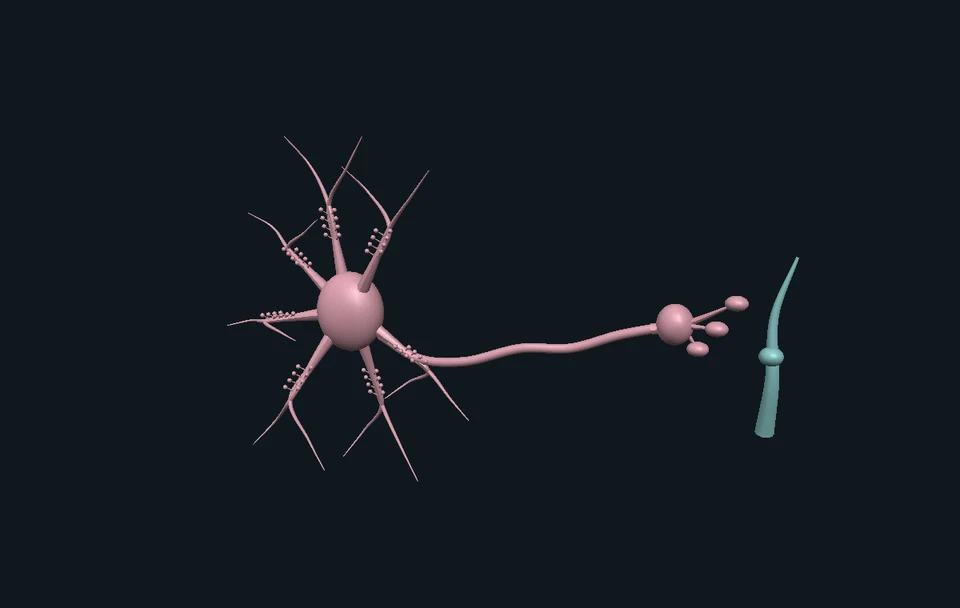
A touch changes your skin. Specialized sensing structures help turn that change into electrical activity. Your nervous system uses many signals together when you feel an object.
- Predict ridge-crossing frequency from speed and spacing.
- Distinguish a changing contact from a sustained contact.
- Explain mechanotransduction in plain language.
- Separate a stimulus, nerve activity and the personal experience of pain.
- Read real microscopy and a molecular model without mistaking either for a live nerve recording.
Make a prediction
The same ridges move twice as fast. What happens to the number passing each second?
- It doubles
- The ridges become twice as far apart
- Each nerve must fire exactly twice as often
Read the explanation
f = |v| / λ. Double speed at fixed spacing and the ridge-crossing frequency doubles. That does not establish a matching change in nerve firing or perceived roughness.
Understand it
How does skin detect touch?
Press or slide an object, and skin changes shape. Specialized sensory endings and associated cells respond to mechanical changes. Their electrical activity carries information toward the central nervous system. The skin is an active sensing surface, not just wrapping.
What is mechanotransduction?
It means turning mechanical change into an electrical response. Mechanically activated ion channels let charged particles cross a cell membrane. PIEZO2 is important for several forms of touch sensing, but it is not the only molecule involved in sensation.
Why does moving feel different from holding?
Some touch-sensitive nerve fibers emphasize changes at contact or movement. Others continue responding while a deformation is held. These are called rapidly and slowly adapting responses. A smaller changing response does not mean the object has disappeared.
How do fingers feel texture?
Spatial patterns and movement-dependent vibrations both contribute. For a regular grating, more ridges pass each second if it moves faster. Real texture perception combines information across receptors, movement and the nervous system; ridge frequency alone cannot predict how rough something feels.
Are pain and nociception the same?
No. Nociception is neural processing of potentially tissue-damaging stimuli. Pain is a personal sensory and emotional experience. You cannot read someone’s pain from the number of dots, a pressure slider or a single nerve signal. The definition from IASP explicitly distinguishes the two.
Look closer at the science
A spatial pattern becomes a temporal pattern
If successive ridges are λ millimeters apart and pass at speed v millimeters per second, one cycle takes T = λ / |v| seconds. Therefore f = |v| / λ cycles per second, or hertz. At 20 mm/s and 4 mm spacing, f = 5 Hz. At 40 mm/s and 8 mm spacing, it is also 5 Hz. The equation counts the external stimulus, not action potentials.
Which skin are we looking at?
This is an authored illustration of glabrous, or hairless, fingertip skin. Its outer epidermis includes the stratum corneum. Beneath it is the dermis; deeper tissue includes subcutaneous fat. Meissner corpuscles sit in dermal papillae near the surface. Merkel cell–neurite complexes are associated with the basal epidermis. These structures differ in arrangement and response; our enlarged cutaway shows one Meissner-like corpuscle, not a complete receptor atlas.
What did human recordings show?
Johansson and Vallbo’s 1979 study recorded 334 low-threshold mechanoreceptive units in awake humans. Response types and receptive-field properties differed across units and hand regions. Their measurements do not support labeling every touch as one universal sensor or assigning one response rate to everyone.
From genes to selective human evidence
Chesler and colleagues studied two people with biallelic loss-of-function PIEZO2 variants in 2016. Their selective sensory and movement findings help establish PIEZO2’s role in humans. A small, unusual genetic study is not a population-wide sensitivity test, and the 3D structure here is separately sourced from mouse PIEZO2.
What the three-part structure establishes
Wang and colleagues’ 2019 cryo-electron microscopy study determined a mouse PIEZO2 assembly, deposited as PDB 6KG7. We preserve the three protein chains and their common coordinate frame. The smoothed envelope is a rendering of deposited atom positions; it is not a density map, observed channel opening, or a propeller spinning in skin.
Temperature involves different molecular routes
The discovery of heat/capsaicin-sensitive TRPV1 and cold/menthol-sensitive TRPM8 helped identify molecular contributions to temperature sensing. Neither establishes one exact sensation temperature for everyone or makes the channel the sole detector of all hot or cold experiences.
Where this is used
Why a phone can “tap” your finger
A vibrating actuator creates changing mechanical input without a person tapping you. Haptic design uses timing and patterns to communicate. Our periodic grating helps separate the pattern’s timing from how an individual interprets it.
Why a prosthetic hand needs more than a grip motor
Measuring contact and communicating useful feedback are different engineering problems. A force sensor can record a physical input; it does not automatically reproduce the many signals and personal experience of natural touch.
Try it yourself: Become a texture detective
Supplies
- A soft cloth
- A smooth sheet of paper
- A clean lid with rounded ridges
- A pencil and observation sheet
- Meet your three surfaces
Look at the cloth, paper and rounded ridges. Describe each before touching: soft-looking, smooth, lined or something else. Predict which changes you might notice during movement.
- Touch, then keep still
Rest your finger gently on one comfortable surface. Keep the contact steady for a short moment. Write what you notice. A changing feeling does not prove that the contact has stopped.
- Move just one thing
Keep your finger lightly resting while moving the surface slowly beneath it. Use a little faster movement only if comfortable. Keep the same surface and light contact. Describe the difference without assigning it a nerve firing rate.
- Compare and record
Try another surface with similarly gentle movement. Record the material, whether it moved, your description, and what you tried to keep the same. Use your own words; there is no correct personal sensation score.
- Find the model’s boundary
The on-screen surface has regular spacing that can be counted. A cloth has a much more complicated pattern. Explain why one ridge-frequency equation cannot predict everything you felt. Compare descriptions kindly; different observations do not rank anyone’s nerves.
Can one surface feel different when you change how it moves?
Use comfortable, gentle contact on your own skin, or make visual observations instead. Stop if something is uncomfortable. No sharp points, hot or cold objects, chemicals, blindfolds or pain challenges. This is not a nerve-health test.
Check your understanding
Ridges 4 mm apart pass at 20 mm/s. What is 5 Hz describing?
- Five ridges pass a fixed point each second
- Exactly five nerve impulses each second
- Five units of pain
Answer and explanation
Five ridges pass a fixed point each second 20 / 4 = 5 cycles per second. It describes the repeated external stimulus, not a neural or pain measurement.
You double the ridge spacing. How can you keep the same crossing frequency?
- Halve the speed
- Double the speed
- Reverse direction without changing speed
Answer and explanation
Double the speed Doubling both |v| and λ leaves |v| / λ unchanged. Try 20 mm/s with 4 mm spacing, then 40 mm/s with 8 mm spacing.
The tile stops moving while the finger still rests on it. What stopped?
- All forms of touch sensing
- New ridges passing the fixed point
- The contact itself
Answer and explanation
New ridges passing the fixed point Zero speed means zero ridge-crossing frequency. Contact and sustained skin deformation can remain.
A rapidly adapting response becomes small during a held touch. Has the object necessarily disappeared?
- Yes
- No; a changing response and a held contact are different
- Yes, unless the person looks
Answer and explanation
No; a changing response and a held contact are different Some fibers emphasize change. Others can continue responding during a sustained deformation. Our comparison is qualitative.
Can this skin model tell you how much pain another person feels?
- Yes, count the glowing sensors
- Yes, use ridge speed
- No; nerve activity alone cannot establish pain
Answer and explanation
No; nerve activity alone cannot establish pain Pain is a personal sensory and emotional experience. Nociception and pain are distinct; there is no calibrated pain output here.
What role does PIEZO2 help explain?
- Turning mechanical change into electrical activity
- White blood cells swallowing all germs
- Every feeling, including memories
Answer and explanation
Turning mechanical change into electrical activity PIEZO2 is a mechanically activated ion channel important in several sensory functions. Immune defense and all subjective experience are different questions.
The three-part PIEZO2 structure resembles a propeller. Does the evidence show it spinning?
- Yes, like a tiny fan
- No; shape does not establish spinning motion
- Yes, whenever we rotate the camera
Answer and explanation
No; shape does not establish spinning motion The viewer turns a static structure. Neither the coordinates nor our camera movement is an experimentally measured gating trajectory.
You and a friend describe the same cloth differently. What should you record?
- Both observations and the conditions
- Who has healthier nerves
- Only the description you expected
Answer and explanation
Both observations and the conditions Record observations and controlled comparisons. This activity is not a calibrated sensory test and cannot rank another person’s experience.
Sources and model limits
- The finger and enlarged cutaway are original teaching geometry, not a scan, patient anatomy or a biomechanical contact solver. Layer thicknesses, receptor size and skin indentation are illustrative.
- Only regular ridge motion has quantitative timing: f = |v| / λ. Playback is slowed fivefold. The ridge counter counts travel in complete ridge intervals from trial start, not neural spikes.
- Press–hold–release signals are qualitative authored response envelopes. Heights and playback times are not measured firing rates or physiological thresholds.
- The mouse PIEZO2 model uses PDB 6KG7 assembly 1. Nonprotein carbohydrate atoms and alternate B atom locations are omitted. Its inspection separation is not a molecular motion or a working partial channel.
- The microscopy is a static, licensed image of human skin. Optical brightness is not electrical activity. The study included ten participants; this lesson does not infer personal receptor density.
- This lesson introduces nociception and pain; it does not model pain intensity, diagnose sensation, or reproduce all sensory pathways. Independent subject and learner review of the finished lesson is pending.
Human mechanoreceptive units have distinct response and field properties
Original study of 334 low-threshold units in awake humans. Supports response diversity and differences across hand regions.
Johansson & Vallbo · Journal of Physiology, 1979Touch perception uses spatial and temporal information
Primary texture study separating spatial patterns and temporal vibration-related signals; do not equate our grating frequency with perceived roughness.
Weber et al. · PNAS, 2013PIEZO channels contribute to mechanically activated currents
Original discovery work using mechanically activated currents and gene screening.
Coste et al. · Science, 2010PIEZO2 contributes to Merkel-cell mechanotransduction
Mouse preparation; distinguish associated Merkel cells from sensory nerve endings and from every type of human touch receptor.
Woo et al. · Nature, 2014Selective human evidence for PIEZO2 function
Two participants with biallelic loss-of-function variants; not a general-population sensitivity model.
Chesler et al. · NEJM, 2016The molecular asset is mouse PIEZO2, biological assembly 1
Wang et al., Nature 2019, DOI 10.1038/s41586-019-1505-8. Three protein chains; local processing and omissions are documented in the downloadable manifest.
RCSB PDB · 6KG7PDB archive coordinate data can be reused
CC0 archive data. Credit the experimental authors and archive; the local smoothed geometry is a derived representation.
RCSB PDB · usage policyActual Meissner corpuscles can be imaged non-invasively in human skin
Infante, Bennewitz, Klein & Meinke, IJMS 2023, 24(8), 7121. Ten participants; complete Figure 2 reused under CC BY 4.0 with original panel labels and scale bars. LSM, not a nerve recording.
Infante et al. · human skin microscopy, 2023Basic skin layer organization
Institutional anatomy guide for epidermis, dermis and subcutis; our glabrous fingertip illustration excludes hair follicles.
NIH / NCI SEER · layers of the skinPain and nociception are distinct
IASP’s revised definition includes notes on personal experience and why sensory-neuron activity alone cannot establish pain.
IASP · revised pain definitionMolecular evidence for heat and capsaicin sensing
Original TRPV1 discovery study. No home heat or chemical experiment is prescribed.
Caterina et al. · Nature, 1997Molecular evidence for cold and menthol sensing
Original TRPM8 discovery study. This is not a universal temperature-to-sensation calibration.
McKemy, Neuhausser & Julius · Nature, 2002Two-point testing can mislead when treated as a pure acuity test
Research comparing two-point discrimination and orientation discrimination; our home observation is not a sensory-health test.
Tong, Mao & Goldreich · Frontiers, 2013Discovery history of temperature and touch sensing
Scientific background to the 2021 Nobel Prize, without claiming sensation was completely solved.
Nobel Prize · 2021 scientific backgroundIndependent subject review is pending.
Read the sources and model assumptions