INTERACTIVE EXPLANATIONHow do genes pass from parents to offspring?
Inspect a real fruit fly reconstruction, choose inherited copies, exchange chromosome segments and test why a probability does not promise an exact family. Follow linked markers from parent to gamete to offspring.
Enable JavaScript to change the conditions and run the interactive experiment.
Make a discovery
Offspring inherit combinations of DNA. The arrangement of variants on chromosomes helps determine which combinations can travel together.
- Trace one specified allele from each parent into an offspring genotype.
- Distinguish an allele, genotype, tracked trait class and whole organism.
- Explain a probability ratio without treating it as a quota for each family.
- Compare together/cis and split/trans arrangements with unchanged individual allele totals.
- Follow one exchange between nonsister chromatids while conserving the marker copies.
- Distinguish a selected demonstration, a seeded simulation, adult counts and a gene-expression measurement.
Make a prediction
The parent keeps the same four marker copies, but their chromosome arrangement changes. Must the offspring-pair probabilities stay the same?
- Yes, only the totals matter.
- No, linked arrangement can change which pairs travel together.
- The parent must acquire new genes.
Read the explanation
Phase changes the pairing of variants while preserving individual copy totals.
Understand it
Begin with a real organism
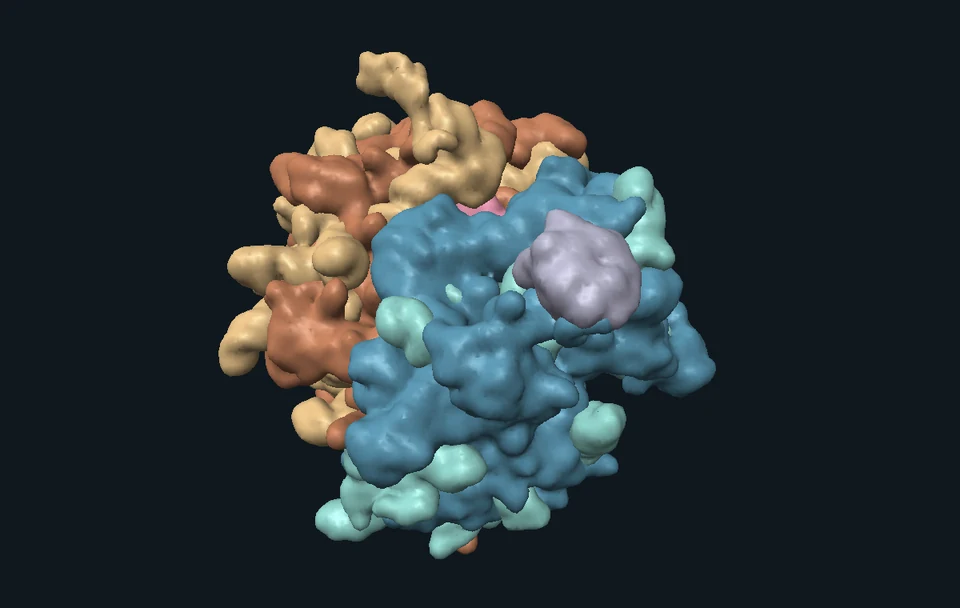
The source-derived fruit fly gives the lesson an anatomical anchor: a body, wings, eyes and six legs. It comes from a prepared female specimen used in NeuroMechFly research. Our controls do not reshape that specimen into supposedly measured mutant offspring. The genetic workbench is a separate, declared model.
A copy from each parent
Start with two known +/vg parents. Each supplies one allele at this marker through a gamete. Combining their contributions gives +/+, +/vg or vg/vg. Under the selected recessive mapping, only vg/vg produces the vestigial-wing class. A parent’s reference-wing appearance does not by itself reveal both copies.
Possibilities are not a schedule
The four equally likely parental-copy combinations give genotype probabilities 1/4, 1/2 and 1/4. Grouping the specified wing classes gives 3/4 and 1/4. Four independent offspring need not include one of every possibility. The sample activity retains every generated outcome, including surprising batches.
Keep linked markers together
The body marker and wing marker lie on the same chromosome. A parent can carry the variants together on one homolog, or one variant on each homolog. The arrangements contain identical per-marker totals but different pairs. This arrangement is phase: together/cis or split/trans.
Follow an exchange
After DNA replication there are four chromatids in the paired homologs. The demonstration selects one chromatid from each homolog and exchanges a segment. Two marker pairs change while the total copies are conserved. The diagram then follows one selected gamete product, not four equally functional eggs.
Combine, count, question
In the testcross, the other parent always supplies (b, vg). This makes the sampled marker pair readable from the offspring’s tracked class under our specified recessive mapping. Compare exact probabilities with a saved sample, then trace any offspring back to its two gametes.
Look closer at the science
Alleles, genotypes and phenotypes
An allele is a version at a genetic locus. A genotype describes the inherited copies being tracked; a phenotype is an observed characteristic. Neither two markers nor a single outward feature specifies a whole organism. Dominance is a relationship between selected alleles and a measured trait in a context, not a measure of strength, quality or frequency.
A source example of linkage
Morgan’s 1916 example assigns 17% total recombinant combinations to this female-fly cross. For a together-phase parent, the four canonical pairs (+,+), (+,vg), (b,+), (b,vg) receive probabilities 83/200, 17/200, 17/200 and 83/200. Split phase reverses which pairs are common. Each individual variant still has probability 1/2.
One event and an ensemble are different
One selected nonsister exchange makes two recombinant chromatids among four. That count does not establish that 17% of cells undergo the illustrated event. The historical fraction is a separate ensemble description. Our model does not derive a crossover frequency from marker spacing or draw multiple exchanges, gene conversion or every meiotic product.
The organism matters
Standard Drosophila melanogaster male meiosis lacks the usual meiotic crossing over. Our male comparison therefore supplies only the two parental marker combinations, with probability 1/2 each. This is a species-specific comparison, not a rule about human fathers or all male animals. The tester remains fixed when the modeled parent changes.
A transparent random experiment
The seeded testcross uses one uniform pseudorandom draw per offspring and exact integer probability weights summing to 200. A generated run stores its phase, mode, seed and sample size. Later control changes prepare a new run without reinterpreting the saved results. The expected count N × p can be fractional; observed simulated counts are integers.
Adult counts can include survival effects
Morgan and Lynch’s 1912 recent-cross F2 count lists 1,081 reference-wing and 280 vestigial-wing adults; the reciprocal-cross F2 lists 1,213 and 273. These are preserved source observations, not generated data. An adult sample can be affected by viability and observation as well as the inherited combinations. The original investigators considered viability.
Genes act in a developmental context
FlyBase now names the historical body-color b gene Adc, on chromosome arm 2L. The vg gene lies on 2R and contributes, with other factors, to wing and haltere identity. The schematic does not convert arm-local sequence coordinates into a distance or apply the same phenotype mapping to every possible allele.
Expression is not anatomy
Voigt and colleagues measured normalized vg mRNA in pooled adult samples at 17 °C and 28 °C. Their reported adult-male ratios are 1.76 for Sweden and 2.28 for France. Those are expression ratios, not wing-size multipliers or individual forecasts. The source has an unresolved ZI/ZK population-label mismatch; the affected ratios are not assigned here.
Where this is used
Understanding family resemblance
Recombination and segregation help explain new combinations. Many human traits involve numerous genes, development and environments. This fly example introduces the mechanism while deliberately stopping short of predicting anyone’s appearance, ancestry or health.
Designing an informative cross
A specified tester can make otherwise hidden allele combinations easier to trace. The testcross workbench shows why knowing the parental genotypes and phase matters before interpreting offspring counts.
Reading scientific evidence
An anatomical reconstruction, a counted adult sample, a normalized expression measurement and an ideal probability table answer different questions. Preserve their units, assumptions and provenance when comparing them.
Try it yourself: Keep the chromosome together
Supplies
- One sheet of paper and a pencil
- Large paper rectangles in two distinguishable sets
- Two envelopes or cups
- A recording sheet
- Draw one copy from each parent
Put a + and a vg card in each parent’s envelope. Draw one from each without looking, record both, then replace and mix. Repeat twelve times; tally genotypes before grouping wing classes.
- Keep the linked pair
Make two (+,+) and two (b,vg) chromosome cards. Draw a whole card from one envelope, pair it with a fixed (b,vg) tester, record, replace and mix. This no-exchange paper model produces only original pairs.
- Choose one exchange
Lay out two duplicated homologs. Cover the right-hand marker on one card from each homolog with exchanged labels. Identify the two changed pairs. This shows a selected exchange, not a 17% frequency.
- Change the phase
Start with two (+,vg) and two (b,+) cards. Repeat no-exchange draws. Compare the possible pairs without changing the individual marker totals.
- Separate your conclusions
Write what was possible, what each model predicted, and what your paper trials actually produced. Explain which assumption changes if you draw the two markers independently.
How can the same individual marker totals lead to different combinations being passed on?
An original paper model, not chromosome chemistry or a human trait predictor. Use large cards and tear paper if needed. No family histories, biological samples or insect breeding.
Check your understanding
Two known +/vg parents both have reference wings. Can their offspring be vg/vg in this model?
- No, appearance copies itself exactly.
- Yes, each can supply a vg copy.
- Only if the offspring chooses that trait.
Answer and explanation
Yes, each can supply a vg copy. The offspring inherits one copy from each parent.
A model gives 1/4 probability of vestigial wings. What must happen in four offspring?
- Exactly one must have vestigial wings.
- The probabilities do not guarantee an exact count.
- Four offspring are enough to prove the gene is absent.
Answer and explanation
The probabilities do not guarantee an exact count. Independent draws can produce many different finite counts.
Together and split parents have the same allele totals. What differs?
- Which two markers share each homolog.
- The number of body-marker copies.
- The species becomes human.
Answer and explanation
Which two markers share each homolog. Phase describes marker arrangement across the homologs.
Why not draw the body marker and wing marker from separate independent envelopes in the linked model?
- Paper cannot represent anything.
- It would discard the assumption that the markers travel together.
- It would make every offspring identical.
Answer and explanation
It would discard the assumption that the markers travel together. A whole chromosome card preserves the linked pair.
One exchange changes two of four chromatids. Does that establish a 17% recombinant rate?
- Yes, every four-copy drawing means 17%.
- No, a selected event and an ensemble rate are different.
- Yes, the drawing measures all real meioses.
Answer and explanation
No, a selected event and an ensemble rate are different. The chosen demonstration does not derive the historical rate.
What does the standard male fruit-fly no-crossover comparison imply?
- Every male animal follows this rule.
- Only the two parental marker pairs are produced in this model.
- Offspring stop receiving DNA from both parents.
Answer and explanation
Only the two parental marker pairs are produced in this model. This is a species-specific meiosis comparison.
A real adult sample has fewer vestigial-wing flies than the ideal ratio predicts. What is a useful next question?
- Did survival or observation differ before adults were counted?
- Which offspring tried harder?
- Should we edit the counts to fit 3:1?
Answer and explanation
Did survival or observation differ before adults were counted? Adult counts can include processes after fertilization.
A study reports 1.76× as much normalized vg mRNA at one measured temperature. What follows?
- Wings must be 1.76× longer.
- Expression differed in that measured context; this does not predict individual appearance.
- Human siblings must look identical.
Answer and explanation
Expression differed in that measured context; this does not predict individual appearance. The measured quantity is mRNA abundance, not anatomy.
Sources and model limits
- This is a selected historical fruit-fly marker model. It is not a human appearance predictor, genetic report, clinical interpretation or full-genome model.
- The genotype-to-class mapping is specified for the chosen recessive variants. Other alleles and developmental contexts can have other effects. Recessive does not mean weak, uncommon or inferior.
- The 17% recombinant fraction is a historical example, not a universal gene-pair rate. The independent-marker branch is an explicit counterfactual that removes linkage; it does not relocate the genes.
- The selected exchange is a schematic between nonsister chromatids. It conserves tracked copies but omits DNA chemistry, full meiosis, additional chromosomes, mutation, gene conversion, nondisjunction and crossover-position modeling.
- Simulations assume equal segregation, gamete success and observation, with no differential survival. The actual adult counts remain separate from these assumptions and are never edited to fit a target ratio.
- The real fly is a prepared female micro-CT-derived research reconstruction. Source assembly pose, subsequent transforms and our materials do not measure a living posture, pigment variation or predicted mutant wing shape.
- The 2019 expression figure measures pooled adult vg mRNA at two temperatures, not wing length or a continuous response curve. The ZI/ZK source-label conflict remains unresolved; only unambiguous SU and FR male ratios are tabulated.
- Local interactions use invented marker choices and seeded simulations. No family history, genetic information, biological sample or personal phenotype is requested. No narration or provider request is triggered automatically.
Gamete formation reduces chromosome number and combines parental genetic contributions through reproduction.
National Human Genome Research Institute glossary. The fly workbench tracks a selected pair, not every chromosome or meiotic product.
NHGRI · meiosisMatching chromosome regions can exchange genetic material during meiosis.
Primary institutional genetics explanation; the segment animation is explicitly schematic.
NHGRI · crossing overMany traits involve multiple genes and can be influenced by environment.
Supports the boundary against using a two-marker fly cross to predict human appearance.
NHGRI · polygenic traitCurrent gene identity, chromosome arm 2L and pigmentation-related biology.
Curated Drosophila record. The historical symbol b is retained on teaching cards to match the historical cross; modern name Adc is taught alongside it.
FlyBase · Adc, formerly black/bChromosome arm 2R, wing/haltere development and allele-dependent phenotypes.
Curated record. Does not imply that all vg mutations are equivalent, recessive or confined to the displayed phenotype.
FlyBase · vestigial/vgTogether/split marker arrangements, female 83%/17% example and male no-crossover comparison.
A Critique of the Theory of Evolution, Figure 66 and accompanying text. Public domain in the US. Historical quantitative example retained; obsolete historical molecular explanations are not reused as modern fact.
T. H. Morgan (1916) · original linkage exampleOriginal recent and reciprocal F2 adult counts, with viability considered.
The Linkage of Two Factors in Drosophila That Are Not Sex-Linked, printed page 177. Counts are transcribed as source observations and kept separate from generated simulations.
Morgan & Lynch (1912) · counted fliesTemperature-associated expression differences in the measured adult sample context.
Genes 10(7):498, Figure 1 and Table 3. CC BY 4.0 figure retained in full. Three biological replicates; technical repetitions are not independent biological samples. ZI/ZK label conflict disclosed.
Voigt, Erpf & Stephan (2019) · vg expressionPrepared female micro-CT reconstruction and a detailed fly simulation model.
Nature Methods, source Methods. The paper has separate copyright; no restricted paper figure is copied. The geometry is reused under its repository license.
Lobato-Rios et al. (2022) · NeuroMechFlySource-owned meshes, assembly transforms and Apache 2.0 license.
Pinned commit; 65 mesh parts and 334,525 triangles retained. Public provenance records hashes, scale and coordinate conversion. Authored colors and inspection pose are identified separately.
NeuroMechFly · source geometry and licenseIndependent subject review is pending.
Read the sources and model assumptions